
Table of Contents
- How to Measure Your Living Room for the Right Rug
- Standard Rug Sizes for Living Rooms
- Living Room Rug Placement Rules That Anchor the Space
- Rug Size for Sectional Sofas and Accent Chairs
- Choosing Material, Pile Height, and Shape for Your Layout
- Decorating Tips for Non-Designers: Getting Proportion Right
- Common Rug Sizing Mistakes to Avoid
- Frequently Asked Questions
Last Updated: September 30, 2026
How to Measure Your Living Room for the Right Rug
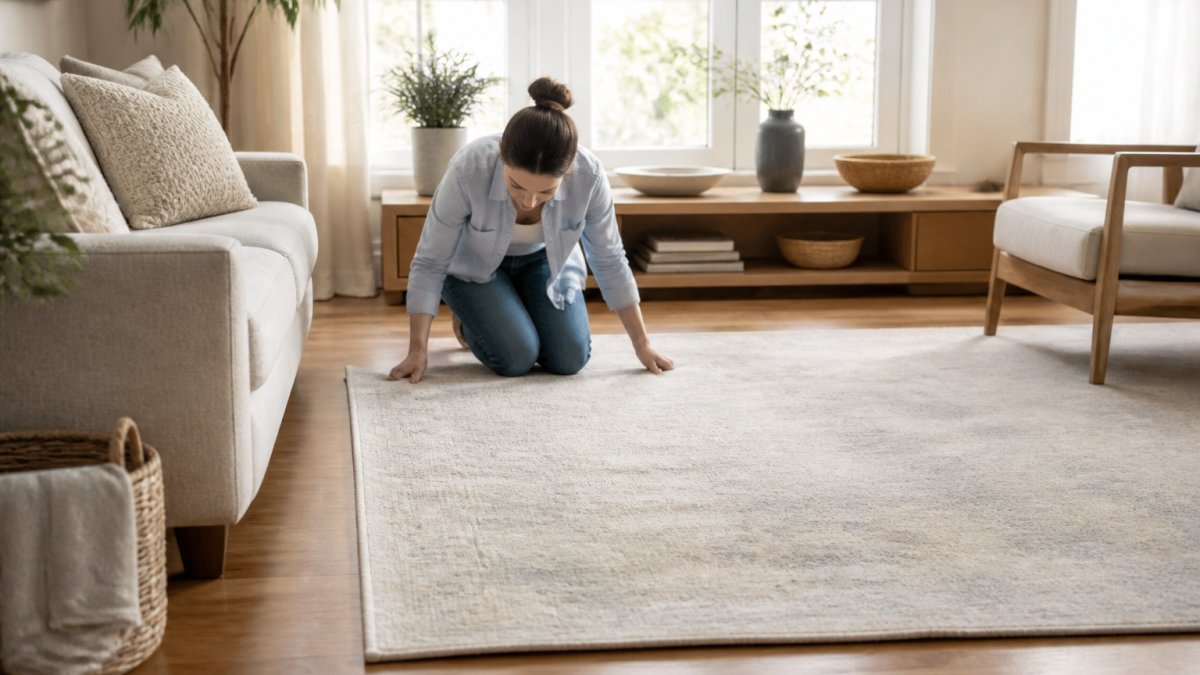
A rug size guide for living room layouts starts with one measurement, not a guess. The most common mistake is buying a rug that floats in the middle of the floor with no furniture touching it.
Here’s how to get it right:
- Measure your room’s length and width in feet.
- Measure your sofa’s full width and depth.
- Mark the 18-inch border zone around the seating area.
- Choose a rug that extends at least 6 inches under each piece of furniture.
- Confirm the rug leaves 6-12 inches of bare floor between its edge and the walls in small rooms.
Measuring Furniture and Traffic Flow
Traffic flow determines where the rug can safely end. Walk your normal path through the room and note where feet naturally land.
- Seating area: Rug should sit under the front legs of every main seat.
- Walkways: Leave at least 24 inches of clear floor for main paths.
- Doorways: Keep the rug edge 6 inches from any door swing.
Standard Rug Sizes for Living Rooms
Standard living room rug sizes are 5×8, 8×10, 9×12, and 10×14 feet for rectangular rugs, plus 6, 8, and 10-foot rounds. The right choice depends on your room’s dimensions, not its square footage alone.
| Room Size | Recommended Rug | Best For |
|---|---|---|
| Under 100 sq ft | 5×8 or 6-foot round | Small apartments, studios |
| 100-200 sq ft | 8×10 | Standard living rooms |
| 200-300 sq ft | 9×12 | Open-concept spaces |
| 300+ sq ft | 10×14 or larger | Great rooms, oversized layouts |
Matching Rug Size to Room Scale
Scale and proportion matter more than exact dimensions. A rug that covers 60-75% of the seating area’s footprint feels correctly sized.
Living Room Rug Placement Rules That Anchor the Space
The core living room rug placement rules come down to anchoring furniture, not filling floor space. Every main seat should have at least its front legs on the rug.
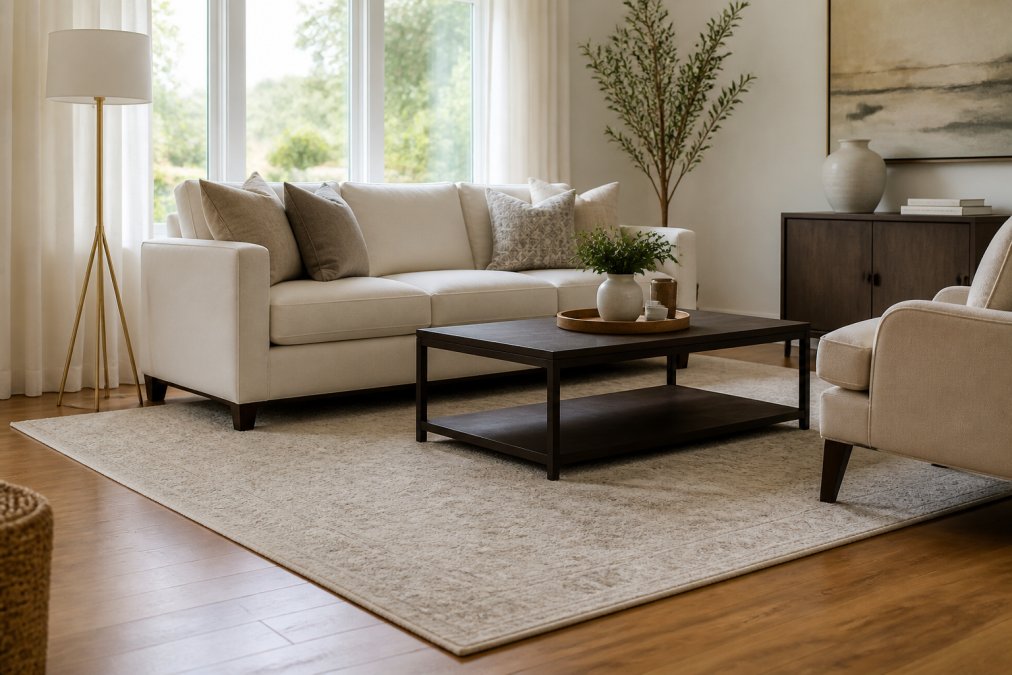
Photograph your room from the main entry point before buying. The camera flattens depth, so if the rug looks too small in a photo, it will look too small in person.
The 18-Inch Rule and Border Clearance
The 18-inch rule states that a rug should extend 18 inches beyond the edge of your furniture on all exposed sides. This creates a visible border that frames the seating area.
- Too small: Rug ends flush with the sofa, no border.
- Correct: 18-24 inches of rug visible beyond the outermost furniture.
- Too large: Rug touches or nearly touches the walls.
Rug Size for Sectional Sofas and Accent Chairs
Sectionals break the standard rug-sizing math because the L-shape creates two different “long” sides. The right rug size for a sectional sofa is typically 8×10 or 9×12, but the correct number depends on which arm of the sectional you measure against.
Sectional Configurations and the Rug Size That Fits
L-shaped sectional (two arms, one corner): Measure the longer run from the outside of one arm to the outside of the other, then add 18 inches on each exposed end. A 9-foot-long sectional run usually lands on a 9×12 rug. An 11-foot run pushes you to a 10×14.
Accent Chairs: Front Legs, Angles, and Pairings
For accent chairs, the front legs should sit on the rug even if the chair is positioned at an angle. The rule does not change with rotation, the front two legs stay on the rug, the back two stay off.
- Single accent chair in a reading nook: A 5×8 or 6-foot round works if the chair and a small side table are the only furniture.
- Two accent chairs facing a sofa: Both chairs need front legs on the rug. If the chairs sit at 45-degree angles, the rug must be wide enough that the front legs of both chairs land on it without the rug edge cutting through the chair footprint.
- Accent chair paired with an ottoman: The ottoman should sit fully on the rug. If the ottoman floats off the edge, the grouping reads as disconnected.
A Quick Layout Check Before You Buy
Use painter’s tape to mark the rug’s footprint on the floor. Sit in every seat. If your feet land on bare floor when you are seated in the main sofa, the rug is too small. If the tape line cuts through the front legs of any main seat, the rug is too narrow.
Front Legs vs. All Legs on the Rug
Front legs on the rug is the standard rule for large rugs. All legs on the rug works only when the rug is large enough to hold the entire furniture grouping.
- Front legs only: Best for 8×10 rugs in medium rooms. Keeps the rug from crowding walls and preserves walkway clearance.
- All legs: Best for 9×12 and larger in spacious rooms. Creates a fully anchored look but requires 18-24 inches of bare floor between the rug edge and the walls.
- No legs on rug: Avoid unless the rug is purely decorative. A rug that no furniture touches reads as a floor mat, not an anchor.
Placing all legs of a heavy sectional on a thin rug causes edge curling within months. Use a rug pad underneath to prevent slipping and protect hardwood flooring. For sectionals over 200 pounds, choose a pad at least 0.25 inch thick.
If your sectional is longer than 12 feet, standard rug sizes will not give you an 18-inch border on both ends. In that case, either accept a smaller border on one side or price a custom-cut rug, the custom option often costs less than sizing up to a 12×15 and trimming the excess floor coverage.
Choosing Material, Pile Height, and Shape for Your Layout
Material durability should match the room’s traffic, but the decision is not just wool-versus-synthetic. Each fiber has a specific failure mode in a living room, and knowing the failure mode is what prevents a return.
Material by Room Condition
- Wool: Holds up best in high-traffic living rooms. Resists crushing, hides dirt, and cleans well. Downsides: costs more upfront and can shed for the first few months. Best for main living rooms with daily foot traffic.
- Wool blend (wool + synthetic): Lower cost than pure wool, similar look, slightly less durable. A reasonable middle ground for medium-traffic rooms.
- Polypropylene (olefin): The most stain-resistant common fiber. Best for homes with kids, pets, or frequent spills. Downsides: less soft underfoot and can pill in high-abrasion zones.
- Polyester: Soft, affordable, and stain-resistant. Best for low-to-medium traffic and bedrooms. Downsides: crushes under heavy furniture and shows matting faster than wool.
- Viscose and silk: Luxurious sheen and feel, but show wear and water stains quickly. Best for low-traffic, formal living rooms. Avoid in homes with pets or young children.
- Jute, sisal, and seagrass: Durable natural fibers with a casual look. Best for layered rugs or low-traffic zones. Downsides: rough texture, not soft underfoot, and can stain from moisture.
Pile Height and What It Changes
Pile height affects both feel and function, and it also changes how the rug interacts with doors, furniture, and cleaning equipment.
- Low pile (under 0.25 inch): Best for high-traffic and pet-friendly homes. Easy to vacuum, does not catch chair legs, and works under doors. Also the right choice under recliners and rolling chairs.
- Medium pile (0.25-0.5 inch): Balanced comfort and durability. The default for most living rooms. Check door clearance, a medium-pile rug plus a pad can stop a door from swinging.
- High pile (over 0.5 inch): Best for low-traffic, formal living rooms. Feels plush but crushes under heavy furniture, traps debris, and is harder to vacuum. Avoid under sectionals and recliners.
Shape Follows Furniture Arrangement
Shape should follow furniture arrangement, not the room’s outline. A rectangular room does not require a rectangular rug.
- Rectangular: Suits most layouts. The default for sofas, sectionals, and paired seating.
- Round: Works under round dining tables, in reading nooks, and in square rooms where a rectangular rug would leave awkward corner gaps. An 8-foot round fits a 10×10 seating area.
- Oval: Softens long, narrow rooms. Good for a sofa-and-two-chairs grouping in a room that is more than twice as long as it is wide.
- Square: Useful in symmetrical layouts with four chairs around a central table. Less common in living rooms but effective in square floor plans.
- Runner: Not a living room rug, but useful in adjacent hallways to connect the living room to the rest of the home visually.
The Maintenance Trade-Off Nobody Mentions
Larger rugs are harder to clean. A 9×12 or 10×14 rug usually will not fit in a standard residential washing machine, and many cannot be dry-cleaned affordably. Before sizing up, check:
- Can you vacuum the full rug without moving furniture every week?
- Is there a spot in the home to lay it flat for drying after a spot clean?
- Does the material require professional cleaning, and how often?
Match pile height to traffic, material to durability needs, and shape to your furniture’s arrangement. Then check the maintenance math before you commit to a size. All four must align for the rug to feel intentional.
Small apartments and studios where a single oversized rug unifies the living, dining, and workspace zones into one cohesive layout, choose low-pile polypropylene for easy cleaning in tight quarters.
Decorating Tips for Non-Designers: Getting Proportion Right
Decorating tips for non-designers start with a simple rule: let the rug define the room, not the walls. Cohesion comes from repeating one or two colors from the rug into pillows, art, or throws.
Common Rug Sizing Mistakes to Avoid
The most common rug sizing mistakes can be frustrating. Here are some to avoid:
- Buying for the room, not the furniture. A rug should anchor the seating area, not mirror the room’s dimensions.
- Skipping the rug pad. Without one, rugs slide, curl, and wear unevenly.
- Ignoring traffic flow. A rug that blocks a main walkway gets kicked up at the corners.
- Choosing size before layout. Arrange furniture first, then measure.
- Forgetting the border. No visible border means the rug reads as a floor mat.
Frequently Asked Questions
What is the perfect rug size for a living room?
There is no single perfect size, but the most common living room rug dimensions are 8×10 and 9×12 feet. An 8×10 works well in rooms roughly 10×12 feet, while a 9×12 suits larger spaces or open-concept layouts. The deciding factor is whether your furniture sits fully or partially on the rug. Measure your seating area first, then choose the size that extends at least 18 inches beyond the sofa and chairs on all sides.
Which rug is better for my living room, 9×12 or 8×10?
Choose 9×12 when your sofa plus two accent chairs span more than 8 feet wide, or when you want all furniture legs on the rug. Choose 8×10 for smaller living rooms, apartments, or when only the front legs of furniture will rest on the rug. Measure the distance from the front of your sofa to the far wall, then subtract 18 to 24 inches of walking clearance. If that number is under 10 feet, an 8×10 is the better fit.
How much floor space should show around a living room rug?
Leave 18 to 24 inches of bare floor between the rug edge and the walls in a standard living room. In larger rooms, 24 to 36 inches looks more balanced. This border keeps the rug from looking wall-to-wall and preserves traffic flow around the seating area. In small apartments or studios, you can shrink the border to 12 inches if the rug still anchors the furniture without crowding doorways or walkways.
How do I position a rug with a sectional sofa?
Place the sectional so its front legs sit on the rug, with the rug extending at least 18 inches past the chaise or end of the sofa. For large sectionals, a 9×12 or 10×14 rug usually works better than 8×10. If the sectional is L-shaped, angle the rug so the longer side runs parallel to the main sofa section. Pull the coffee table to the center of the rug, keeping 14 to 18 inches between the table and the sofa for comfortable reach.
Getting the rug size wrong is the fastest way to make a beautifully furnished room feel unfinished. At Verra Luxe Home, our curated collection of premium decor includes rugs and accent pieces designed to work together, so proportion and cohesion come built in. Every piece is thoughtfully crafted for beauty and durability, blending artistic elegance with practical function. Shop Now and transform your living space into a sanctuary of style.