Table of Contents
- Scale and Proportion in a Small Living Room: The Basics
- Step 1: Measure Your Room and Map a Floor Plan
- Step 2: Use Painter’s Tape to Test Furniture Footprints
- Step 3: How to Choose Art Scale for Small Walls
- Step 4: Find the Best Rug Size for Small Living Room Layouts
- Step 5: Understand Visual Weight in Interior Design
- Step 6: Balance Furniture Size, Ceiling Height, and Vertical Space
- Common Mistakes to Avoid
- Frequently Asked Questions
Last Updated: September 16, 2026
Scale and Proportion in a Small Living Room: The Basics
The difference between a cramped room and a composed one usually comes down to math, not taste. Learning how to use scale and proportion in a small living room means matching every piece to your actual dimensions before you buy, and a tape measure settles more debates than a mood board ever will. This guide walks through six steps, from floor plan to final placement, plus the mistakes that undo good intentions.
Scale is the size of an object relative to the space and objects around it. Proportion is the relationship between those sizes, such as a coffee table that sits at roughly two-thirds the length of the sofa it serves. Scale is about fit. Proportion is about harmony.
That distinction matters because most small-room advice stops at “buy smaller furniture.” Shrinking everything produces the opposite of the intended effect: undersized pieces leave awkward gaps, and a room reads as unfinished rather than open. The fix is measured placement, and it starts on paper.
Step 1: Measure Your Room and Map a Floor Plan
Start by drawing your room to scale on graph paper, one square per foot, and mark every fixed element: doors, windows, outlets, radiators, and vents. A floor plan turns guesswork into a checklist and prevents the classic error of buying a sofa that blocks a doorway swing.
Key Measurements to Record
- Overall room dimensions, wall to wall
- Ceiling height, measured at the lowest point
- Doorway widths and swing direction
- Window sill heights and widths
- Distance between the longest wall and any traffic path
Record clearance needs before you shop. A common approach is 14 to 18 inches between a sofa and coffee table, and roughly 30 to 36 inches for main walkways. Measure twice, write it down, and bring the plan to every showroom visit or online order. Rooms that feel tight almost always fail on traffic flow, not on furniture count.
Photograph your floor plan and tape the measurements inside a kitchen cabinet. When you spot a piece you love, you can check the numbers in seconds instead of re-measuring the room for the third time.
Step 2: Use Painter’s Tape to Test Furniture Footprints
Painter’s tape is the cheapest design tool you own. Before ordering anything, mark each furniture footprint on the floor at full size, then live with the outlines for a few days to test traffic flow and sightlines in real use.
Measure the actual width and depth of the sofa, chair, or table you are considering, then lay tape to match. Step back from the doorway and ask three questions: Can two people pass without turning sideways? Does the outline crowd the focal point, whether that is a fireplace, television, or window? Does the arrangement still work when the room is full of people?
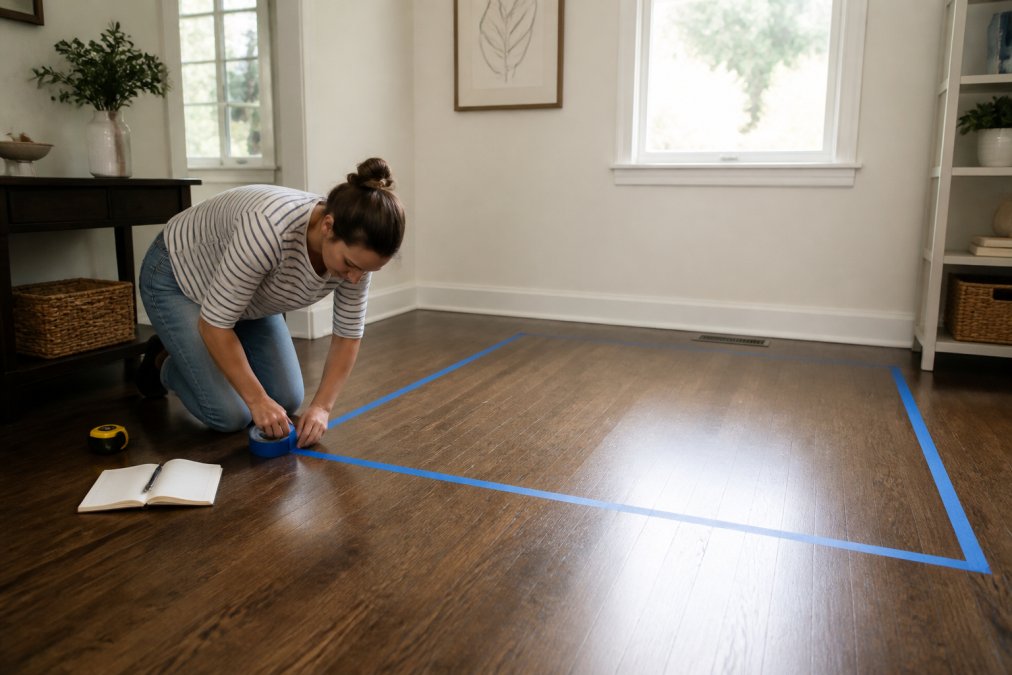
What most guides miss is that tape also reveals proportion problems. An outline that looks balanced on a floor plan can feel oversized once it sits against a low ceiling or beside a narrow window. If the tape rectangle dominates the room, no upholstery color will fix it.
Skipping the tape test is the most expensive shortcut in small-room design. A sofa that is six inches too deep can choke your main walkway, and return shipping on oversized furniture often costs more than the piece itself.
Step 3: How to Choose Art Scale for Small Walls
Art is the fastest way to change how large a small living room feels, and it is also where scale errors are most visible. A single small canvas centered on a wide wall makes both the art and the room look undersized; a piece that crowds the ceiling makes the wall feel shorter than it is. The fix is to size art to the wall, not to the furniture beneath it.
A common starting point is to let art occupy roughly 60 to 75 percent of the wall width it hangs on.
Hanging Height and Sightlines
Center art at eye level, generally 57 to 60 inches from the floor to the middle of the piece. In a small room, sightlines matter as much as wall space: art placed too high pulls the eye upward and exposes the gap between furniture and ceiling, which flattens the room. Art placed too low can collide visually with sofa backs and table lamps.
Using Art to Add Vertical Scale
This is the angle most small-room guides skip. When floor space is fixed, the only direction left to grow is up. A tall, narrow canvas, a vertical gallery stack, or a floor-to-ceiling curtain panel hung close to the ceiling all add height without consuming a single square foot of floor. The mechanism is simple: vertical lines draw the eye upward, and the eye reads a taller sightline as a larger room.
Before you commit to a gallery wall, cut paper templates to the exact size of each frame and tape them to the wall. Live with the arrangement for a day. Proportion problems that are invisible on a mood board become obvious once the shapes are at full scale on your actual wall.
Step 4: Find the Best Rug Size for Small Living Room Layouts
The best rug size for a small living room is one large enough to sit under the front legs of every main seating piece. A rug that floats in the middle of the floor shrinks the room and breaks the seating group into disconnected islands.
Step 5: Understand Visual Weight in Interior Design
Visual weight in interior design is how heavy an object feels to the eye, regardless of its actual mass. A glass table can weigh more visually than a light wood bench if it is dark, glossy, or complex in shape. In a small living room, visual weight is often the difference between “cozy” and “cramped”, and it is the lever most people never think to pull.
Visual Weight vs. Physical Size
A physically small piece can dominate a room if it is dark, patterned, or highly reflective. A physically large piece can recede if it is light in tone and simple in form. Balance the two: pair a heavy-looking sofa with a visually light coffee table, and give dense bookcases breathing room rather than filling every shelf.
Legs, Skirts, and the Perception of Scale
This is the small-room angle most guides miss. Two sofas of identical dimensions can make a room feel completely different depending on what happens below the seat. A skirted sofa, fabric running straight to the floor, reads as a solid block, and solid blocks visually shrink a room because you cannot see floor beneath them. A sofa on exposed legs, especially tapered or raised ones, lets the eye travel under the piece, which reads as more floor area and therefore a larger room.
When a small room feels off, check visual weight before you check size. Swapping one dark, bulky item for a lighter-toned equivalent, or trading a skirted sofa for one on visible legs, often fixes the imbalance without moving a single wall.
Step 6: Balance Furniture Size, Ceiling Height, and Vertical Space
Low ceilings and tall furniture fight each other. Keep the tallest pieces below the window line where possible, and use vertical space to draw the eye upward without adding bulk at floor level.
Common Mistakes to Avoid
- Buying a matching set. A full suite in one fabric and finish reads as a showroom, not a home, and it locks the layout into one configuration.
- Shrinking everything. Undersized furniture leaves dead space and makes proportions feel accidental.
- Ignoring the focal point. Every arrangement should orient toward one anchor, whether that is a fireplace, a view, or a piece of art.
- Filling every surface. Negative space is a design element; crowded shelves and tables cancel the openness you are trying to create.
- Skipping the tape test. Outlines on the floor catch problems that showroom lighting hides.
If that sounds like a lot of measuring, it is, and that is the point. Small rooms reward precision, and the pieces that survive the tape test are the ones worth investing in. Verra Luxe Home offers a sophisticated and inspiring collection of premium decor, thoughtfully curated to transform your living space into a sanctuary of style. Our commitment to high-quality, durable decor ensures each item not only delights the eye but also reflects your unique values and inspires creativity.
Frequently Asked Questions
What is the 3-5-7 rule in decorating?
The 3-5-7 rule is a styling guideline for arranging accessories in odd-numbered groups: three, five, or seven items. Odd numbers create visual tension that feels more natural than even groupings. In a small living room, use the lower end of the range. Three objects on a coffee table or five on a bookshelf keep surfaces from feeling cluttered while still looking intentional.
What are the most common scale mistakes in small living rooms?
The biggest mistakes are choosing furniture that is too large for the room dimensions and hanging art too high. Oversized sofas block traffic flow, while undersized rugs leave bare floor around the edges and make the room feel disjointed. Another frequent error is ignoring ceiling height, which leads to tall bookcases that overwhelm the space or low art that leaves a visual gap.
How do you choose the right size rug for a small living room?
Choose a rug large enough that at least the front legs of your main seating pieces rest on it. In a small living room, a rug that covers most of the floor area between furniture boundaries creates a cohesive functional zone. Leaving a border of bare floor around the rug is fine, but the rug should anchor the seating group rather than float in the center.
How does the 60-30-10 rule apply to small spaces?
The 60-30-10 rule divides a room’s color palette into 60 percent dominant color, 30 percent secondary color, and 10 percent accent color. In a small living room, apply this to visual weight as well: let lighter tones dominate large surfaces like walls and upholstery, use mid-tone pieces for secondary elements, and reserve bold or dark accents for small decor items.