Table of Contents
- Why Custom Cabinetry Alternatives Are Gaining Ground in 2026
- Cabinet Refacing vs Replacement: Which Fits Your Post-Renovation Plan?
- DIY Kitchen Cabinet Upgrades That Look Custom
- Modular and Semi-Custom Systems: A Middle Path
- Durable Decor for Family Homes: Styling Beyond the Cabinets
- Smart Storage Accessories and Sustainable Choices
- Post-Renovation Maintenance and Long-Term Care
- Frequently Asked Questions
Last Updated: October 1, 2026
Why Custom Cabinetry Alternatives Are Gaining Ground in 2026
Homeowners finishing a kitchen renovation increasingly turn to alternatives to custom cabinetry for post renovation styling instead of ordering new custom boxes. The reason is practical: custom cabinetry involves long lead times, high cost, and a fixed layout you cannot easily change later. This guide from Verra Luxe Home walks through the options that deliver a high-end look without a custom-shop timeline.
Alternatives to custom cabinetry for post renovation styling are non-permanent or semi-permanent solutions, including refacing, modular systems, paint, trim, and open storage, that upgrade a finished kitchen’s appearance and function without rebuilding the cabinet boxes from scratch.
Why does timing matter so much? Custom orders typically require precise measurements before installation, and any delay in one trade stalls the rest of the renovation. Non-permanent and modular options let you style the kitchen as the renovation wraps, then adjust as your needs change. According to the U.S. Department of Energy’s home improvement guidance, cabinet-level updates are among the most common homeowner projects because they improve both function and perceived value.
The core trade-off is control versus speed. Custom cabinetry gives you exact dimensions and finishes; alternatives give you faster installation and easier future changes. Most post-renovation projects benefit from the second option.
::: Balancing these practical advantages against the desire for a bespoke aesthetic often leads homeowners to explore luxury cabinetry alternatives that bridge the gap between modular convenience and high-end design.
Cabinet Refacing vs Replacement: Which Fits Your Post-Renovation Plan?
Refacing keeps your existing cabinet boxes and swaps the visible surfaces. Replacement removes the boxes entirely. The table below summarizes how each approach fits a post-renovation timeline.
| Factor | Refacing | Replacement |
|---|---|---|
| What changes | Doors, drawer fronts, veneer | Full boxes and fronts |
| Timeline | Days, not weeks | Weeks to months |
| Best for | Solid boxes, dated fronts | Damaged or poorly laid-out boxes |
| Layout changes | None | Full flexibility |
| Disruption | Low | High |
When Refacing Wins
Refacing wins when your cabinet boxes are structurally sound but the doors look dated. You keep the existing layout, which matters if the renovation already locked in plumbing and electrical runs. A common mistake is refacing boxes that have water damage or sagging shelves; the new fronts will not fix a failing frame.
When Replacement Makes More Sense
Replacement makes more sense when the boxes are damaged, the layout wastes space, or you want frameless construction and inset doors. In practice, this is a bigger project than most post-renovation budgets allow, which is why so many homeowners stop at refacing.
DIY Kitchen Cabinet Upgrades That Look Custom
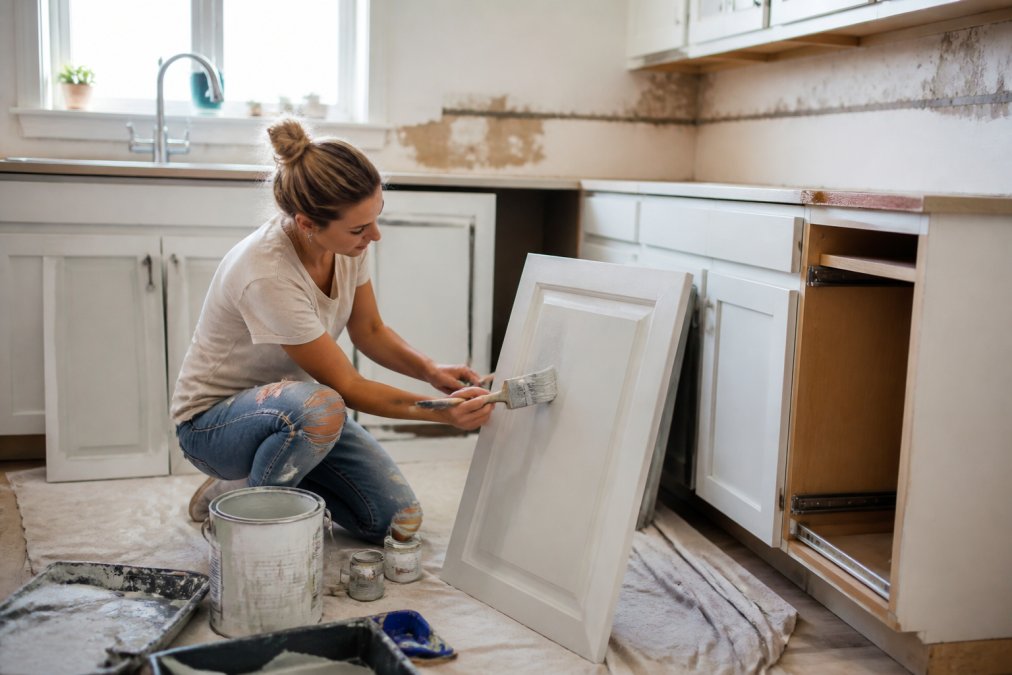
Painting is the cheapest path to a custom look. A careful prep and a quality paint finish can make builder-grade boxes read as intentional design. Low-VOC finishes are worth the extra cost in an occupied home because they cut fumes during and after application.
Hardware is the fastest upgrade of all. Swapping builder-grade pulls for soft-close hinges and weighted drawer fronts takes an afternoon and changes how the kitchen feels. Crown molding along the top of the cabinets and trim work around the base add architectural weight without new boxes.
Skipping surface prep before painting is the most common DIY failure. Paint applied over grease or glossy factory finish peels within months, and you will repaint the whole run, not just one door.
Modular and Semi-Custom Systems: A Middle Path
Modular systems sit between stock cabinets and full custom work. They use fixed box sizes you assemble into a cabinetry layout, then dress with aftermarket doors and drawer fronts. This is where the market has shifted most in recent years, and it is the single best answer for a post-renovation kitchen where the boxes are already set but the fronts, internals, and finish still feel builder-grade.
The mechanics matter more than the brand list. A modular system works because the frame dimensions are standardized, which means a third-party door maker can cut fronts to fit without a site visit. You measure the frame opening, order fronts to that spec, and mount them on the existing hinge plates. The result reads as custom because the visible surface, the door and drawer front, is what the eye registers, not the box behind it.
IKEA’s SEKTION frames are the best-known example. They are affordable, widely available, and highly modular, which makes them a strong base for customization.
Modular plus aftermarket fronts is the highest-leverage move in a post-renovation kitchen. You keep the boxes the renovation already paid for and change only what the eye sees.
Durable Decor for Family Homes: Styling Beyond the Cabinets
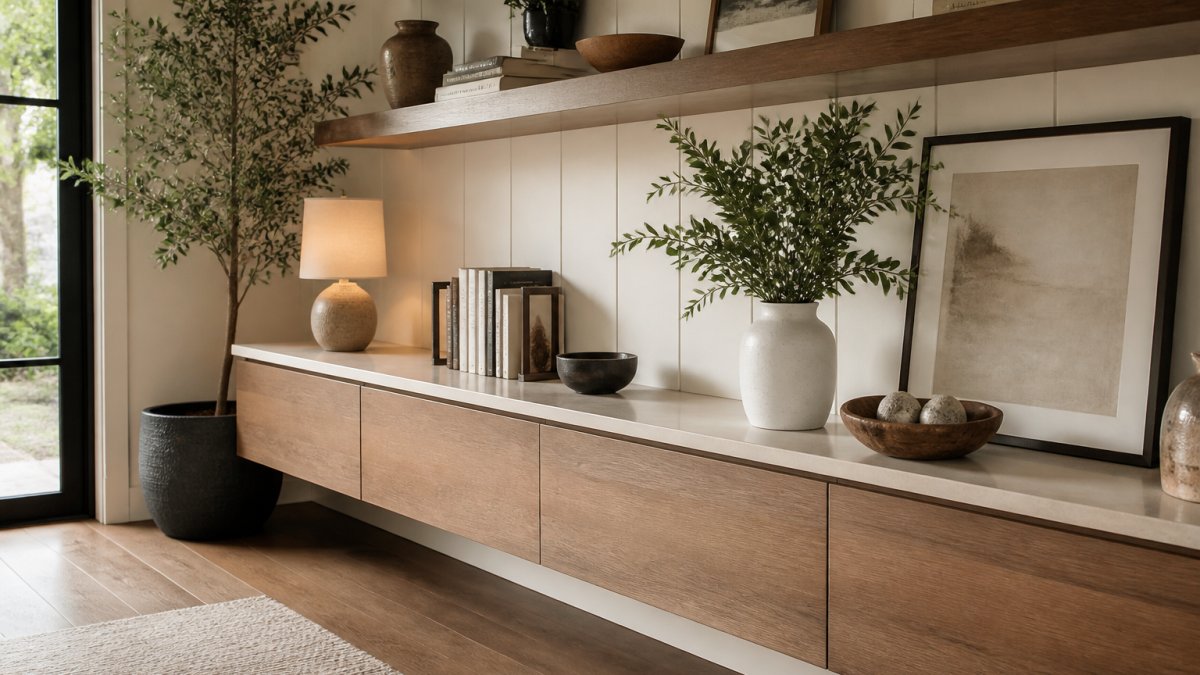
Durable decor for family homes is decor chosen for how it survives daily use, not just how it photographs. In a household with kids and pets, the finish on a cabinet matters less than what sits on and around it.
If you are styling open shelves in a busy kitchen, group items by function rather than color. A shelf that holds daily dishes reads as intentional; a shelf of matching decorative objects reads as staged and gets cleared the first time someone needs a plate.
Smart Storage Accessories and Sustainable Choices
Smart storage accessories turn unused cabinet depth into working space, and they are the cheapest way to make a builder-grade kitchen feel custom from the inside out. Most competitors stop at aesthetics; the functional layer is where a post-renovation kitchen actually earns its keep.
- Pull-out organizers for base cabinets. A full-extension pull-out converts a deep, dark lower cabinet into a drawer you can see into. This is the single biggest quality-of-life change in a kitchen with standard-depth boxes.
- Drawer dividers and tiered inserts for utensil and cutlery drawers. Adjustable dividers cost little and stop the daily shuffle.
- Lazy Susan and corner carousels for blind corner cabinets, which are the most wasted space in any layout.
- Under-shelf and stackable risers to create a second tier inside tall cabinets.
- Door-mounted racks on the inside of cabinet doors for lids, cutting boards, and foil.
Buy storage accessories after you have lived in the kitchen for two weeks. You will discover which cabinets actually annoy you, and you will spend on the right ones instead of the ones that looked good in a photo.
Post-Renovation Maintenance and Long-Term Care
Maintenance is what determines whether your upgrade still looks sharp in five years. Painted cabinets need gentle cleaning with a damp cloth and mild soap; abrasive cleaners dull the finish and strip sheen over time.
Ignoring a single loose hinge is a small problem that becomes a large one. A door that sags pulls on the frame and the adjacent fronts, and the misalignment is visible across the whole run.
Frequently Asked Questions
What are the best alternatives to traditional kitchen cabinets?
The strongest alternatives include cabinet refacing, which replaces doors and drawer fronts while keeping the existing boxes; DIY upgrades like painting and new hardware; modular systems from IKEA paired with aftermarket fronts; and open shelving for a lighter look. For post-renovation styling, many homeowners combine refacing with durable decor pieces to refresh the space without a full tear-out. Each option balances cost, permanence, and visual impact differently, so the right choice depends on your budget and how long you plan to stay in the home.
Is cabinet refacing a cost-effective alternative to full replacement?
Refacing typically costs less than full replacement because you keep the existing cabinet boxes and only swap doors, drawer fronts, and veneer. It also avoids the mess and downtime of demolition. However, refacing only makes sense if your boxes are structurally sound and the layout works for you. If the boxes are damaged, warped, or you want a different footprint, replacement is the better investment. For post-renovation styling, refacing is often the fastest way to update the look without touching the plumbing or electrical work you just finished.
How can I make builder-grade cabinets look custom after a renovation?
Start with new cabinet hardware in a finish that matches your other fixtures. Add crown molding or trim to the top of the cabinets to bridge the gap to the ceiling. Soft-close hinges and pull-out organizers inside the cabinets make them feel higher-end every time you use them. Painting or refacing the doors in a low-VOC finish can also transform the look. Finally, style the open areas with durable decor pieces that tie the room together. These upgrades cost far less than custom cabinetry but deliver a similar visual and functional result.
What are the pros and cons of open shelving versus closed cabinetry?
Open shelving makes a kitchen feel larger and lets you display durable decor, but it requires keeping items tidy and dusting more often. Closed cabinetry hides clutter and protects dishes from grease and dust, but can feel heavy in small spaces. A mix works well: use open shelving for everyday items you want to show off and closed cabinets for the rest. In family homes, closed storage is usually more practical for breakables and kid-friendly items, while open shelves can hold cookbooks, plants, or decorative pieces that add personality.
What is the new kitchen trend for 2026?
Two-tone cabinetry, warm wood tones paired with painted finishes, and integrated smart storage accessories are leading in 2026. Homeowners are also prioritizing sustainable materials and low-VOC finishes. Instead of full custom builds, many are choosing modular systems with aftermarket fronts or refacing existing cabinets, then layering in durable decor for family homes. The focus is on creating a space that feels personal and functional without the cost and timeline of traditional custom cabinetry. Vertical staggering and frameless construction are also gaining attention for their clean lines.
The hard part of a kitchen renovation is not choosing a finish; it is finding decor that looks refined and survives daily life. Verra Luxe Home offers a curated collection of premium decor built for both, with exclusive pieces that blend artistic elegance and practical function. If you want a finished space that stays beautiful after the renovation ends, shop the Verra Luxe Home collection and style it with confidence.