Table of Contents
- Why Homeware Decorations Define a Room’s Character
- Decor Accent Pillows: The Fastest Way to Shift a Room’s Palette
- Luxury Home Styling Tips for a Curated, Layered Look
- How to Arrange Statement Decor Without Visual Clutter
- Choosing Homeware Decorations That Last: Materials and Care
- Seasonal Home Decor Trends to Watch in 2026
- Frequently Asked Questions
Last Updated: September 29, 2026
Why Homeware Decorations Define a Room’s Character
Homeware decorations are the functional and ornamental objects, sculptural vases, textured accent pillows, that give a living space its visual identity and emotional tone. At Verra Luxe Home, we’ve watched the right pieces turn a builder-grade room into something personal and finished.
The Psychology of Home Decor: How Your Space Shapes Your Mood
Your surroundings influence how you feel before you consciously notice them: a warm palette and soft textures signal safety and calm, while clutter reads as unfinished business.
Decor Accent Pillows: The Fastest Way to Shift a Room’s Palette
Decor accent pillows are the highest-impact, lowest-commitment homeware decorations you can buy: swapping two covers changes a sofa’s entire color story in under five minutes, for far less than reupholstery.
The practical rules most guides skip:
- Vary the scale. Pair one large 22-inch pillow with two smaller 18-inch or lumbar styles so the arrangement reads as designed, not default.
- Mix textures, not just colors. A boucle against a linen against a velvet creates visual interest that a single fabric cannot.
- Use an odd number. Three or five pillows on a sofa almost always photograph and feel better than four.
- Anchor to the room, not the sofa. Pull one pillow color from your art, rug, or curtains so the palette feels intentional.
Luxury Home Styling Tips for a Curated, Layered Look
Layering separates a staged room from a lived-in one. The goal is depth, multiple planes of texture, light, and height, but depth is not accumulation. A layered room has a hierarchy (foundation, middle ground, finishing pieces), and every layer has a job.
The Three-Layer Framework
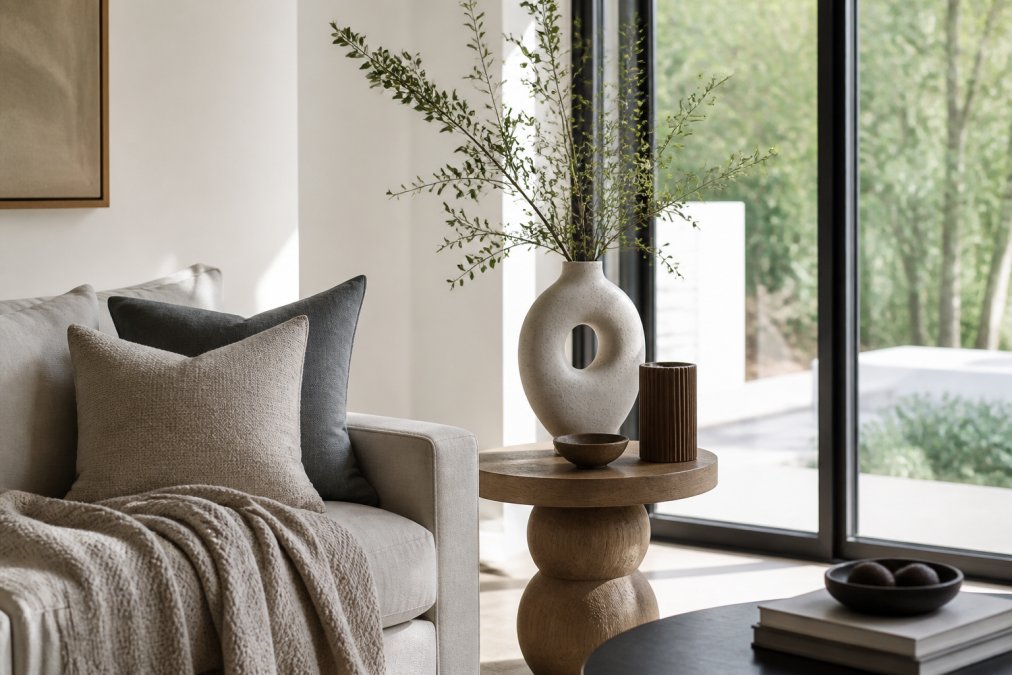
Start with a foundation layer, then build upward: a rug defines the zone, furniture sets the scale, then come the homeware decorations, a sculptural object on the coffee table, a tray for small items, a lamp adding a second light source at eye level. Each layer should add texture, color, or light, never just more stuff.
Scale, Proportion, and the Numbers That Matter
- On a sofa: one 22-inch pillow, two 18-inch pillows, and one lumbar (roughly 12 by 20 inches) is a reliable arrangement. Three to five total pieces is the sweet spot.
- On a coffee table: the hero object should be no taller than about one-third the height of the sofa back, so it does not block sightlines when seated.
- On a console or entry table: aim for three to five objects grouped so they read as one composition. A tray, a tall element, and a low, wide element is a dependable trio.
- On open shelving: leave roughly one-third of each shelf empty. Negative space is what makes the objects on it read as curated rather than stored.
Designers rarely place decor symmetrically in a lived space. Offset your tallest object from center and let one side of a shelf carry more weight. Perfect symmetry reads as a showroom; deliberate imbalance reads as a home.
The most common failure is over-decorating a single surface: a console table holding nine objects gives the eye nowhere to rest. Edit to three to five pieces grouped as one composition.
Sourcing Luxury Pieces: What to Look For
The difference between a piece that looks expensive and one that is expensive usually comes down to details you can inspect:
- Weight and heft. A solid brass frame or a dense stone tray feels heavier than a hollow, plated alternative. Weight is one of the most reliable signals of material quality.
- Joinery and finish. Look for smooth, even glazes without pinholes, seams that line up, and hardware that sits flush. Irregularity in a handmade piece is a feature; irregularity in a machined piece is a defect.
- Maker transparency. Artisan and small-batch makers typically publish where their clay, wood, or metal comes from. Mass-market listings rarely do. Asking where a material was sourced, whether the piece is repairable, and whether replacement parts exist separates a piece you keep for a decade from one you replace in a season.
- Repairability. A lamp with a standard socket, a pillow with a removable cover, or a ceramic piece with a food-safe glaze can all be maintained. Sealed, glued, or proprietary assemblies usually cannot.
Caring for Luxury Materials So They Last
Placement affects lifespan as much as material: direct sunlight fades textiles and bleaches wood, and a brass accent near a bathroom tarnishes faster than one in a dry living room. Rotate textiles seasonally to roughly double their useful life.
- Crystal and glass: dust with a microfiber cloth; avoid ammonia-based cleaners, which can cloud the surface over time.
- Carved or unfinished wood: keep out of direct sun and away from heating vents; a light coat of furniture wax once or twice a year prevents drying and cracking.
- Metal art and frames: dry-polish with a soft cloth; store in a low-humidity room if the piece is not on display.
- Ceramics: hand-wash glazed pieces with mild soap; avoid sudden temperature changes, which can cause thermal shock and hairline cracks.
Buying a statement piece before you know your room’s focal point is the fastest way to waste money. A bold sculptural object placed against competing patterns will look like clutter, no matter how beautiful it is on its own.
How to Arrange Statement Decor Without Visual Clutter
Statement decor works when it has room to breathe: one hero per zone, everything else supporting it.
To arrange a statement piece well:
- Clear the surface entirely before you start.
- Place the hero object off-center, following the rule of thirds.
- Add one taller element and one lower, wider element to frame it.
- Step back five feet. If your eye bounces between objects, remove one.
- Repeat the hero’s color once elsewhere in the room so it feels intentional.
Choosing Homeware Decorations That Last: Materials and Care
Durable homeware decorations come down to materials and how you treat them. The pieces that survive a decade are rarely the trendiest ones; they are the well-made ones.
| Material | Best For | Care Routine | Watch Out For |
|---|---|---|---|
| Glazed ceramic | Vases, bowls | Damp cloth, mild soap | Thermal shock from hot water |
| Solid brass | Accents, frames | Dry polish, soft cloth | Tarnish in humid rooms |
| Linen and cotton | Pillows, throws | Cold wash, air dry | Fading in direct sun |
| Wool and boucle | Textiles, upholstery | Vacuum low, spot clean | Pilling without rotation |
| Stone and marble | Trays, objects | pH-neutral cleaner only | Etching from acidic spills |
Sustainable and Eco-Friendly Sourcing for Conscious Homes
Sustainable decor starts with buying less, better: one handcrafted piece from responsibly sourced materials, kept for years, has a far smaller footprint than three mass-produced items replaced each season.
Seasonal Home Decor Trends to Watch in 2026
Decor trends in 2026 lean toward warmth, texture, and individuality over matching sets, away from showroom-perfect rooms toward spaces collected over time. A trend lasts only if it solves a real problem in the space (light, comfort, storage, mood) rather than simply looking novel in a photograph.
The Four Shifts Gaining Ground
- Warm, earthy color palettes replacing cool grays, with terracotta, olive, clay, and ochre anchoring rooms. These tones read as grounding because they sit at the warm end of the color wheel, which most people associate with natural light and organic materials.
- Sculptural and organic forms in vases, lamps, and objects, favoring handmade irregularity over machined precision. A slightly asymmetric ceramic reads as human-made; a perfect cylinder reads as mass-produced.
- Textural maximalism in textiles, where mixed patterns and layered rugs replace the all-neutral minimalist look. The mechanism is contrast: when two textures sit side by side, the eye registers depth that a single fabric cannot produce.
- Functional decor that earns its place, from decorative storage to statement lighting that actually lights the room. A lamp that only looks good is a sculpture; a lamp that also throws warm light at eye level is decor doing two jobs.
A Seasonal Rotation Calendar That Prevents Waste
Most trend coverage tells you what to buy. More useful is knowing when to rotate what you already own so the room feels new without a single purchase.
- Spring: Swap heavy wool and boucle covers for linen and cotton. Pull cool tones forward and store warm textiles. Add fresh greenery or a single flowering branch in a tall vase.
- Summer: Lighten the rug layer, a flatweave or jute over a wool base reads cooler underfoot. Move darker ceramics to a shelf and bring pale glazes to the foreground.
- Fall: Reverse the spring swap. Layer a wool throw over the sofa arm and reintroduce terracotta and olive accents. This is the season to rotate heavier textiles back in.
- Winter: Maximize texture. Add a second light source at low height (a floor lamp or candle cluster) and lean into deep, saturated tones. Candlelight and warm bulbs read as cozier than overhead light in every season.
How to Adopt a Trend Without Committing to It
The lowest-risk way to test a trend is to apply it to the smallest, cheapest, most replaceable layer first. A pillow cover, candle holder, or single vase costs far less than a sofa or rug and lets you live with a color or texture for a few weeks before committing.
The most reliable trend is not a color or a shape. It is the move toward curated, personal spaces where every piece has a reason to be there. Trend-proof your home by buying what you genuinely love, can maintain, and can rotate, not what a catalog tells you is new this month.
Frequently Asked Questions
What is the most popular home decor right now?
Curated, textural pieces lead 2026 trends: handcrafted ceramics, sculptural lighting, and layered textiles in warm, earthy color palettes. Homeowners are moving away from mass-produced sets toward artisan-made accent pieces that add visual interest and reflect personal taste. Mixing minimalist forms with maximalist texture, such as a smooth stone bowl beside a woven basket, creates a sophisticated interior atmosphere without feeling crowded.
How do you style accent pillows to create a professional look?
Start with a neutral base pillow, then layer in two accent pillows per side in contrasting textures or patterns. Keep the color palette to three tones maximum, and vary sizes so the arrangement feels intentional rather than matched. A designer trick: give the front pillow a light karate chop in the center to add shape and depth.
How can I blend artistic decor with everyday functionality?
Choose functional decor that earns its place: a sculptural bowl that holds keys, a handcrafted tray that corrals remotes, or an ornamental vase that doubles as a candle holder. When a piece serves a daily purpose, it never reads as clutter. Look for durable materials like stoneware, solid brass, or kiln-dried hardwood that hold up to real use while still delivering artistic elegance.
What defines a curated home aesthetic?
A curated home follows a clear point of view rather than a shopping list. That means a consistent color palette, a mix of textures, and a focal point in each room that anchors the spatial arrangement. Curation also means editing: fewer, better pieces with room to breathe. A cohesive look comes from repeating one or two materials, such as brass and walnut, across rooms so each space feels connected.