Table of Contents
- Decor Accent Pillows: What Separates a Curated Room From a Cluttered One
- Pillow Shapes and Sizes: The Measurements That Actually Matter
- Material and Fabric Types That Hold Up in Real Homes
- How to Style Throw Pillows on a Sofa: A Step-by-Step Formula
- Mixing Pillow Patterns and Textures Without the Clash
- Best Pillow Inserts for Decorative Pillows: Fill, Loft, and Longevity
- Ergonomic and Functional Benefits Most Guides Skip
- Care, Cleaning, and Seasonal Refresh
- Frequently Asked Questions
Last Updated: September 27, 2026
Decor Accent Pillows: What Separates a Curated Room From a Cluttered One
Decor accent pillows add color, texture, and personality to furniture, and the difference between a polished room and a chaotic one comes down to restraint, not budget. This guide from Verra Luxe Home breaks down the measurements, fabrics, and styling formulas that make them look intentional.
Accent pillows are the fastest, least expensive way to change a room’s entire mood. Get the shapes and palette right and everything else falls into place.
Pillow Shapes and Sizes: The Measurements That Actually Matter
The three core shapes are square, lumbar, and bolster. Standard squares run 16 to 24 inches; lumbar pillows typically measure 12 by 20 or 14 by 22 inches; bolsters are cylindrical, usually 6 to 9 inches in diameter and 16 to 30 inches long.
Square, Lumbar, Bolster: Where Each Shape Belongs
Square pillows anchor a sofa or bed and carry your boldest pattern. Lumbar pillows sit in front of squares on a sofa, or alone on a bench or chair, where their low profile keeps sightlines open. Bolsters suit daybeds, window seats, and settees, and double as armrests.
| Shape | Typical Size | Best Placement | Styling Role |
|---|---|---|---|
| Square | 16-24 in | Sofa, bed, sectional | Anchor and pattern carrier |
| Lumbar | 12×20 to 14×22 in | Bench, chair, front of sofa | Fills gaps, adds contrast |
| Bolster | 6-9 in diameter | Daybed, window seat | Accent and arm support |
| Round | 14-18 in | Chair, bed | Breaks up angular shapes |
Material and Fabric Types That Hold Up in Real Homes
Fabric choice determines whether your accent pillows survive kids and pets or start pilling within a season. What matters is fiber content, weave tightness, and whether the cover is removable.
Natural Fibers: Cotton, Linen, and Wool
Cotton is the workhorse. A mid-weight cotton canvas or twill with a tight plain weave resists snags and washes well, look for “cotton duck” or “cotton canvas” when durability matters. Standard percale is softer but shows wear faster.
Velvet, Chenille, and Faux Fur: Texture With Rules
Velvet adds depth and reflects light, but pile fabrics show handprints and crush marks. Cotton and performance velvet hold up better than silk or rayon, which flatten permanently in high-contact spots.
Performance Fabrics and the Tight-Weave Test
Performance fabrics now mimic natural fibers closely enough that the difference is hard to spot. Solution-dyed acrylics and olefin blends resist fading and moisture, which is why they dominate outdoor and sunroom pillows. Indoors, a performance weave suits a dining nook or mudroom bench.
| Fiber / Weave | Texture | Washability | Best Room |
|---|---|---|---|
| Cotton canvas | Smooth, matte | Machine wash cold | Living room, family room |
| Linen / linen blend | Slubby, relaxed | Machine wash cold, air dry | Bedroom, formal living |
| Cotton or performance velvet | Plush, light-catching | Spot clean or dry clean | Bedroom, accent chair |
| Chenille | Soft, fuzzy | Spot clean | Family room |
| Faux fur / sherpa | High pile | Spot clean only | Bedroom, seasonal swap |
| Performance olefin / acrylic | Smooth, dense | Machine wash, fade-resistant | Sunroom, dining bench |
The Removable-Cover Rule
A linen pillow with a visible weave and a hidden zipper will outlast a delicate silk sham every time. If you have pets, skip loose weaves and shreddable fringe. Always check for a hidden zipper, a sewn-in cover means one spill ruins the whole pillow, while a removable cover means replacing a $15 cover instead of a $60 pillow.
Buying decorative pillows with sewn-in covers instead of removable ones means one spill ruins the whole pillow. Always check for a hidden zipper before you commit.
A Note on Fill and Sustainability
Fabric gets the attention, but the fill matters just as much for feel and longevity. Look for covers in organic cotton, recycled polyester, or deadstock fabric, now common at mainstream price points. A washable, reusable cover is itself the most sustainable choice, replacing the cycle of buying and discarding whole pillows.
How to Style Throw Pillows on a Sofa: A Step-by-Step Formula
Learning how to style throw pillows on a sofa comes down to one rule: work in odd numbers and vary the size. Start with a base layer, add a contrast layer, then finish with one statement piece. Pull your sofa’s existing colors first, then introduce one new tone.
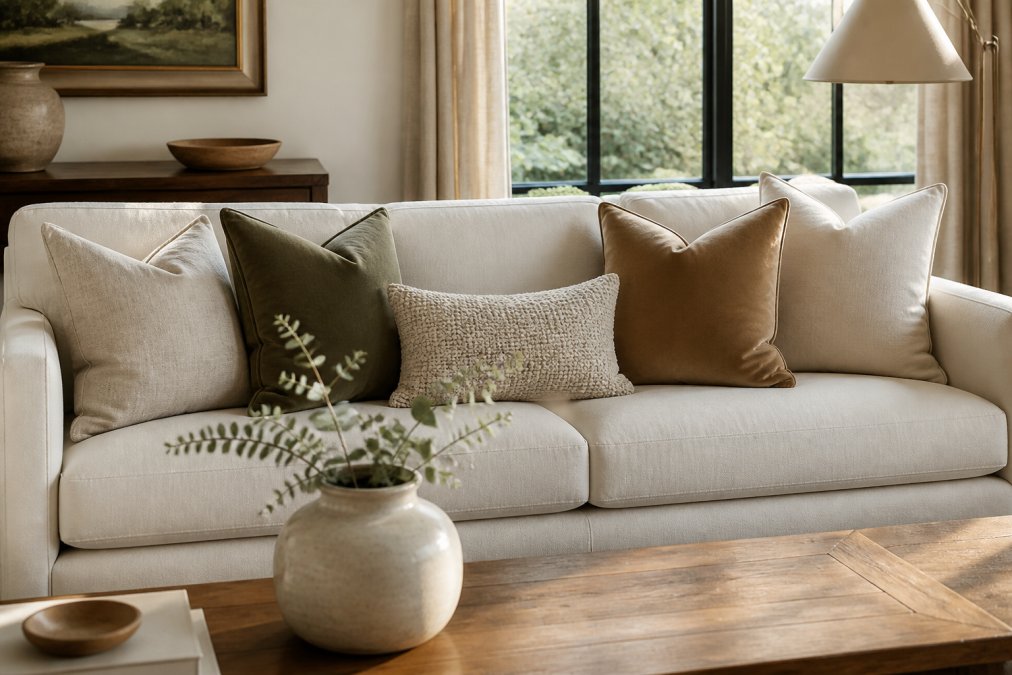
Here’s the formula that works on nearly any sofa:
- Place two large square pillows, one in each corner, in a solid or low-contrast pattern.
- Add two medium square pillows in front, in a complementary pattern or texture.
- Finish with one lumbar pillow centered or offset to one side.
The Odd-Number Rule and the 2-2-1 Arrangement
The odd-number rule exists because even numbers create symmetry, which reads as formal and static; odd groupings feel collected. The 2-2-1 arrangement (two large, two medium, one lumbar) is the most reliable version for a three-seat sofa. For a loveseat, drop to 2-1; for a large sectional, repeat on each end.
Mixing Pillow Patterns and Textures Without the Clash
Mixing pillow patterns and textures works when you vary scale and limit yourself to one dominant pattern per grouping. The failure mode is almost always scale, not color, two medium-scale patterns of similar visual weight fight each other, while large next to small reads as intentional.
The Three-Tier Scale Rule
Think of every pattern as occupying one of three visual weights:
- Large scale: a bold floral, an oversized ikat, a wide stripe, a large medallion. These read as the statement.
- Medium scale: a standard geometric, a small check, a trellis, a mid-size botanical. These read as supporting texture.
- Small scale: a pin dot, a thin pinstripe, a micro-geometric, a tight herringbone. These read as near-solid from across the room.
Pattern Families That Play Well Together
Some pattern types are compatible because they use different line logic:
- Stripes + florals: the stripe’s straight lines contrast the floral’s curves. This is the most forgiving pairing in the book.
- Geometrics + organic motifs: a tight geometric grid against a loose botanical works because the eye reads them as different categories.
- Two patterns in the same family: a large floral and a small floral in the same color family can work, but only if the scale difference is dramatic, think a 6-inch bloom next to a 1-inch sprig.
- Ikat + solid: ikat’s blurred edges already read as textured, so it needs a solid to rest against.
Texture as the Quiet Pattern
Texture does the work of pattern without visual noise. A solid velvet next to a solid linen reads as two materials, not two competing prints, the easiest way to add depth to a neutral sofa.
Building a Color Palette From Your Existing Room
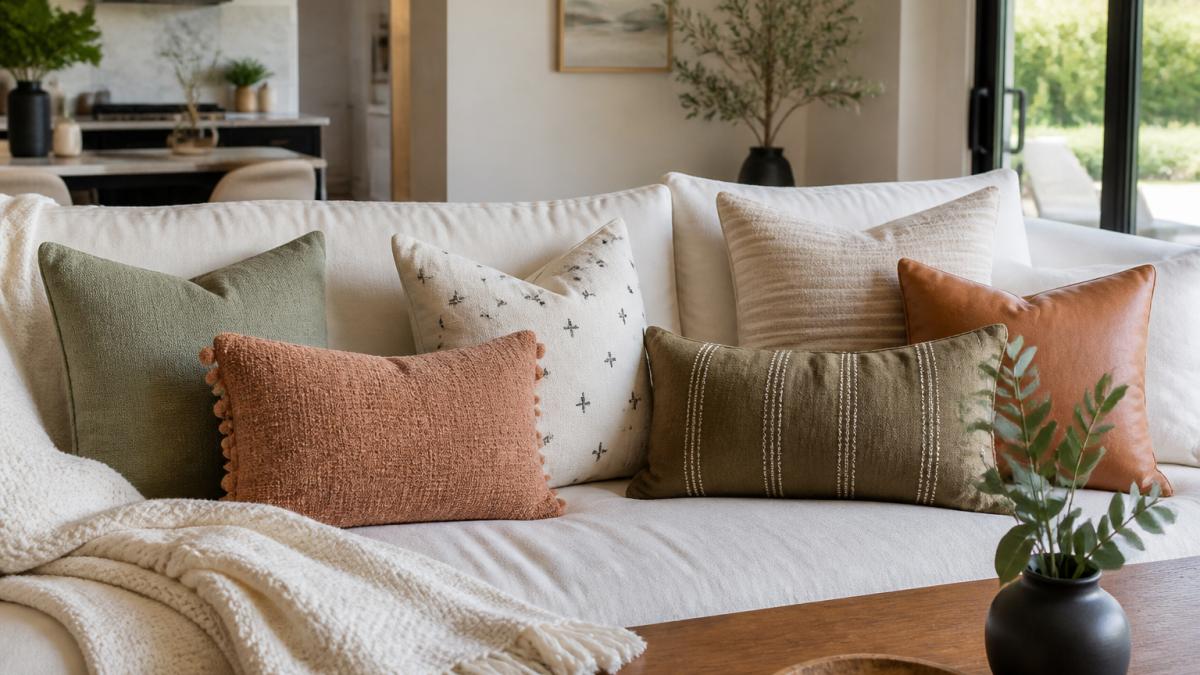
Pull your palette from what’s already in the room, not a catalog. Identify your dominant neutral, secondary tone, and one accent color, then distribute them so the accent appears in the smallest amount, which is why a single rust lumbar can transform an all-neutral sofa.
Photograph your sofa and rug in natural daylight, then match pillow colors to the photo rather than the room. Screens and lighting distort color, and a photo gives you a stable reference when shopping online.
The 2-2-1 Formula, Applied to Pattern
Once you have your pattern tiers and color split, the arrangement formula is simple. On a three-seat sofa:
- Two large square pillows in the corners, one solid, one large-scale pattern, both in the dominant neutral.
- Two medium square pillows in front, one small-scale pattern, one texture-only, both in the secondary tone.
- One lumbar centered or offset, the accent color, in a solid or a very small pattern.
Best Pillow Inserts for Decorative Pillows: Fill, Loft, and Longevity
The best pillow inserts for decorative pillows are down-alternative or feather-down blends sized one to two inches larger than the cover, a 20-inch cover takes a 22-inch insert for a full, tailored look. Polyester is affordable and holds shape but compresses over time; down and down-alternative offer a softer hand and better recovery.
| Fill Type | Loft | Best For | Longevity |
|---|---|---|---|
| Polyester | Medium-firm | Budget, high-traffic rooms | Compresses over time |
| Down-alternative | Soft to medium | Everyday sofas, allergy-friendly homes | Good with fluffing |
| Feather-down | Soft, recoverable | Formal rooms, beds | Excellent |
| Buckwheat or latex | Firm | Ergonomic support | Very long |
Ergonomic and Functional Benefits Most Guides Skip
Accent pillows aren’t purely visual. A correctly placed lumbar pillow supports the lower back and closes the gap between spine and sofa back, while a firm bolster under the knees relieves lower-spine pressure when reclining. For anyone who works from a sofa or reads for long stretches, placement is functional, not just decorative.
Care, Cleaning, and Seasonal Refresh
Care depends on the fabric, so check the label. Most cotton and linen covers are machine washable on cold and should be air-dried to prevent shrinkage; velvet and chenille usually need spot or dry cleaning. Rotate and fluff pillows weekly to prevent compression.
Frequently Asked Questions
How do you mix and match accent pillows for a curated look?
Start with a base of two solid-color pillows in your room’s dominant neutral, then add one patterned pillow and one textured accent pillow. Keep patterns to two at most, and repeat one color from elsewhere in the room, such as an art piece or rug, so the arrangement feels intentional. A 22-inch square base with a 12×20 lumbar in front works for most standard sofas.
What size accent pillows are best for a standard sofa?
A standard 84-inch sofa typically takes two 20- to 22-inch square pillows at the arms and one or two 12×20 or 14×22 lumbar pillows in the center. Bolster shapes work well on benches and settees. Scale matters: oversized 24-inch squares overwhelm a loveseat, while 16-inch squares look undersized on a deep sectional.
How many accent pillows should you have on a couch?
Two to five is the practical range for most sofas. A two-seat sofa takes two squares and one lumbar; a three-seat sofa takes two squares per arm plus one lumbar in the middle. More than five starts to crowd seating, and guests will move them to the floor anyway. Odd numbers usually photograph and feel better than even ones.
What fabrics are best for high-quality decor pillows?
Linen and cotton breathe well and suit everyday seating, while velvet and chenille add depth and hold up to repeated use. Faux fur works as a seasonal accent rather than a year-round base. For homes with kids and pets, look for tight-weave cotton, performance velvet, or removable covers with hidden zippers so you can spot-clean or replace a single cover instead of the whole pillow.