
Table of Contents
- What Defines Luxury Home Decor Today
- High-End Interior Design Trends for 2026
- Materials and Craftsmanship: What Your Money Actually Buys
- How to Verify Authenticity and Provenance Before You Buy
- How to Style Luxury Home Accessories in Any Room
- Finding the Best Luxury Home Decor Stores Online
- Caring for Your Investment Pieces: Maintenance and Preservation
- Frequently Asked Questions
Last Updated: September 10, 2026
What Defines Luxury Home Decor Today
Luxury home decor is the practice of furnishing a space with pieces chosen for material quality, artisanal craftsmanship, and design integrity rather than for volume or novelty. At Verra Luxe Home, we think of it as buying fewer things and choosing each one with intent. That definition matters, because it separates a curated room from an expensive one.
Three markers separate genuine luxury from a high price tag:
- Provenance. You can name the maker, the workshop, and the material source.
- Material quality. Natural stone, solid hardwood, and luxury textiles behave differently over time than veneer and synthetic blends.
- Design integrity. The piece holds its proportions and finish years after the design trends that inspired it have passed.
A common mistake is treating price as the proxy for all three. It isn’t. Plenty of costly decor is mass-produced with a designer label attached.
Judge luxury decor by what it is made of and who made it, not by what it costs. Price follows quality, not the other way around.
High-End Interior Design Trends for 2026
The strongest high-end interior design trends for 2026 favor restraint over spectacle. Textural layering is replacing pattern mixing, and warm neutrals are displacing the cool grays that dominated the past decade. Bespoke furniture and bespoke cabinetry are moving from custom-home projects into ordinary renovations.
What’s driving this? Buyers who lived through a decade of fast decor want rooms that age well. That pushes demand toward natural stone, unlacquered hardware finishes, and luxury textiles with visible weave.
Two shifts are worth planning around:
- Quiet luxury over logo luxury. Statement pieces still matter, but they earn their place through form and material rather than branding.
- Layered lighting. Ambient lighting is no longer a single ceiling fixture. It is a scheme of layers controlled independently.
Design trends move faster than quality does. Adopt the palette and skip the gimmicks.
Materials and Craftsmanship: What Your Money Actually Buys
Material quality is where the real difference between luxury home furnishings and mass-market equivalents shows up. A solid walnut console and a walnut-veneer console can look identical in a showroom photograph. Five years later, they won’t.
Here’s what to inspect before you buy:
| Material | What to Look For | Why It Matters |
|---|---|---|
| Solid hardwood | Visible grain continuing across joints | Veneer delaminates; solid wood patinas |
| Natural stone | Consistent veining, no filled pits | Filled stone chips and stains over time |
| Luxury textiles | Tight weave, high rub count | Loose weaves pill and sag within a year |
| Hardware finishes | Solid brass or bronze, unlacquered | Plated finishes wear through at touch points |
Artisanal craftsmanship shows in the details most buyers never check: drawer joinery, the underside of a table, the weight of a cabinet door. Pick a piece up. Turn it over. If the maker finished the parts you can’t see, they finished the parts you can.
Ask any seller for the maker’s name and the material specification before you buy. A legitimate luxury retailer answers immediately. A vague answer is your signal to walk away.
How to Verify Authenticity and Provenance Before You Buy
Authenticity verification starts with documentation, not with the object. Provenance is the recorded history of a piece: who made it, when, from what, and where it has been. Reputable sellers provide this without being asked. What most guides skip is the mechanism, how verification actually works, and where it breaks down.
Work through this checklist before any significant purchase:
- Request the maker’s name, workshop location, and production date
- Ask for material specifications in writing
- Confirm the piece carries a maker’s mark, stamp, or signature
- Check whether the seller offers a certificate of authenticity
- Verify the seller’s return policy covers authenticity disputes
- Search the maker independently to confirm they exist and produce this category
How Digital Authentication Actually Works
Digital authentication is the newest layer, and it is the one buyers understand least. Three mechanisms are in common use:
- Serial-number registries. The maker assigns each piece a unique number and logs it in a database tied to the workshop. You verify by contacting the maker directly or entering the number in their system. This is the most common approach among small-batch furniture and lighting studios.
- Tamper-evident physical tags. A numbered tag, holographic seal, or embedded chip is affixed to the piece. The tag itself is the proof; removing it voids the record. This pattern shows up most often on upholstery and case goods where a stamp would be hidden.
- Blockchain or distributed-ledger certificates. A digital certificate is issued at the point of sale and transferred with the piece on resale. Adoption is still limited, but it is growing fastest in the secondary market, where buyers want a verifiable chain of custody.
None of these systems is universal, and none is foolproof. A registry only works if the maker maintains it (the FTC). A tag only works if it stays attached. A digital certificate only works if the original seller issued one. Treat each as one signal among several, not as a standalone guarantee.
The Provenance Documents That Actually Matter
When a seller claims provenance, ask for the specific paper trail. The documents that carry weight are:
- Original invoice or receipt naming the maker and the piece
- Certificate of authenticity issued by the maker or an authorized dealer
- Workshop records confirming production date and materials
- Prior sale records if the piece has changed hands
- Restoration or repair records disclosing any intervention
A verbal assurance is not provenance. A photograph of a similar piece is not provenance. If the seller cannot produce at least two of the documents above, price the piece as undocumented, because that is what a future buyer will do.
Why Provenance Protects Resale Value
A documented piece holds value. An undocumented one is priced as anonymous, whatever its actual quality. This is the part most buying guides omit, and it is the part that matters most to a long-term collector.
When you resell, the next buyer runs the same verification you ran. If you cannot pass along the maker’s name, the material specification, and the certificate, the piece trades at a discount to its documented equivalent. In practice, the documentation premium is often larger than any single material upgrade you could have chosen at purchase.
A certificate of authenticity is only as reliable as its issuer. A certificate from the maker or an authorized dealer carries weight. A certificate from an unknown third party, or one printed on generic stock with no contact information, does not. Verify the issuer before you trust the document.
Save every document that arrives with a piece, invoice, certificate, care instructions, and any correspondence with the maker. Store them digitally as well as physically. A future buyer will ask, and a complete file is the difference between a documented piece and an anonymous one.
How to Style Luxury Home Accessories in Any Room

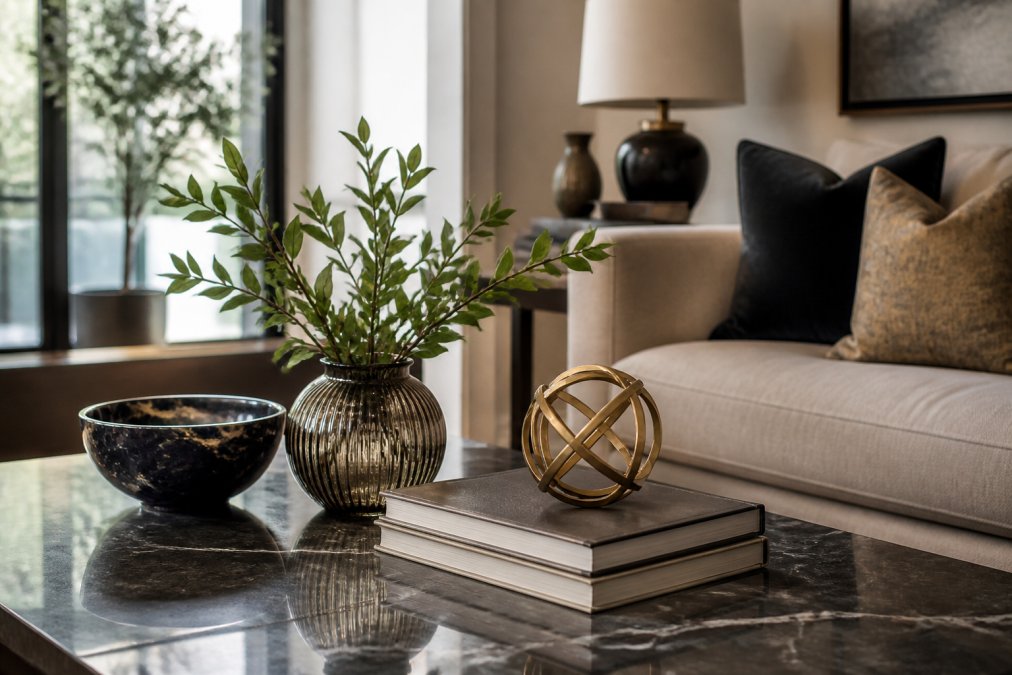
Styling luxury home accessories comes down to grouping, height variation, and restraint. Most rooms fail because there are too many objects competing, not too few.
guidance on interior design principles from the American Society of Interior Designers emphasizes spatial planning before decoration, and it applies directly to shelf and surface styling.
Start with odd-numbered groupings of three or five objects. Vary height so the eye travels. Keep one sculptural piece per surface as the focal point and let the rest support it. Textural layering works here too: pair smooth ceramic with rough stone or woven fiber.
For an entire room, follow this sequence:
- Place the largest piece first and build around it
- Add one item of contrasting height
- Layer in a textural element
- Stop before the surface feels full
That last step is the one people skip.
Finding the Best Luxury Home Decor Stores Online
The best luxury home decor stores online share three traits: they name their makers, they publish material specifications, and they offer real guidance rather than a catalog grid. Everything else is marketing. But those three traits are only the entry ticket. The harder question is how to tell a genuinely well-run retailer from one that has learned to sound like one.
The Signals That Separate Real Retailers From Good Copywriters
When evaluating an online retailer, check these signals:
- Maker transparency. Are designers and workshops named, or is the language vague (“crafted by skilled artisans”)?
- Specification depth. Are dimensions, materials, finishes, and weight listed in full, or only in marketing prose?
- Curation logic. Do the pieces work together, or is it an undifferentiated catalog?
- Design consultation. Can you get help matching pieces to your existing room, and is it included or an upsell?
- Return terms. What happens if a piece arrives damaged or doesn’t fit, and who pays return freight?
- Lead times. Are production and delivery windows stated honestly, or buried?
That curation question is the one buyers raise most often. It is a fair concern. Buying beautiful pieces individually and discovering they clash is a common and expensive outcome.
The Mechanisms That Protect You
A retailer’s policies matter more than its photography. Before you commit to a significant purchase, confirm these four things in writing:
- Inspection window. How long do you have to report damage or a defect after delivery? White-glove delivery often includes a set inspection period; standard freight may not.
- Return freight responsibility. On large furniture, return shipping can rival the cost of the piece. Know who pays before you buy, not after.
- Restocking fees. Some retailers charge a percentage on returns. Ask for the exact figure.
- Authenticity dispute coverage. If a piece turns out not to be what was described, does the return policy cover that, or only damage in transit?
These four terms are where online luxury retail diverges most from in-store. In a showroom, you inspect before you pay. Online, the policy is your inspection.
How to Vet a Maker Before You Buy
A retailer can name a maker and still be selling something the maker did not produce. Cross-check independently:
- Search the maker’s name alongside the category (for example, the maker’s name plus “console” or “lighting”) to confirm they actually produce that type of piece
- Look for the maker’s own website, workshop address, or trade-show presence
- Check whether the maker sells through other authorized dealers, which is a sign of a real production operation
- Ask the retailer for the maker’s contact information directly, a legitimate retailer will provide it
If the maker cannot be found outside the retailer’s own site, treat the provenance claim as unverified.
The Trade-Offs Nobody Lists
Online luxury shopping involves real trade-offs, and honest guides name them:
- Lead times versus immediacy. Made-to-order pieces often take months. In-stock pieces ship faster but offer less customization.
- Photography versus reality. Natural stone and hand-finished wood vary piece to piece. What you see is representative, not identical.
- Price versus service. A lower price often means less consultation, shorter inspection windows, and stricter return terms.
- Curation versus selection. A tightly curated retailer may not have the exact piece you want, but the pieces it does carry will work together.
Verra Luxe Home addresses the curation problem by building each collection around a shared palette and complementary textures.
Homeowners who want a cohesive room rather than a collection of individually attractive pieces, and who value guidance over guesswork.
Judge an online luxury retailer by its policies, not its photography. Maker transparency, written specifications, and clear return terms are the three signals that hold up after the sale.
Caring for Your Investment Pieces: Maintenance and Preservation
Maintenance is what separates investment pieces from decor you replace every few years. Most damage to luxury furnishings comes from routine neglect rather than accidents.
A few habits protect almost everything:
- Keep natural stone sealed and wipe spills promptly
- Rotate textiles away from direct sunlight to prevent uneven fading
- Dust hardwood with a dry cloth rather than a wet one
- Tighten hardware fittings annually
- Store seasonal pieces wrapped, not stacked
Sustainability and ethical sourcing connect directly to preservation. A piece made from responsibly sourced material and built to last is the most sustainable decor choice available, because you buy it once. the Environmental Protection Agency’s guidance on reducing waste through durable goods frames durable products as a core waste-reduction strategy, and furniture is a significant category.
Care instructions vary by material, so ask the maker for specifics. General advice only goes so far with natural stone or hand-finished wood.
Frequently Asked Questions
What are the best websites for buying luxury home decor?
The best luxury home decor stores online combine curated collections with transparent sourcing and detailed product information. Look for retailers that provide material specifications, care instructions, and clear return policies. Verra Luxe Home offers a thoughtfully curated selection of premium decor, and you can explore their collection to find pieces that match your aesthetic. Prioritize stores that share provenance details and stand behind their craftsmanship with responsive customer support.
How do you identify high-quality craftsmanship in home decor?
Examine joinery, material weight, and finish consistency. Hand-finished edges, tight seams, and solid hardware signal quality. For upholstery, check frame construction and cushion density. Natural stone should show unique veining rather than uniform patterns. Ask about the maker’s process and whether traditional techniques like hand-carving or kiln-firing were used. Verra Luxe Home curates pieces that blend artistic elegance with practical durability, so you can trust the craftsmanship behind each item.
What is the 70/30 rule in decorating?
The 70/30 rule suggests balancing 70% timeless, classic pieces with 30% trend-driven accents. This approach keeps your space grounded while allowing room for personality and current styles. Apply it to color, texture, and furniture. Invest the majority of your budget in enduring pieces like a quality sofa or natural stone table, then layer in seasonal or trendy accessories. This strategy protects your investment and ensures your luxury home decor remains cohesive over time.
How can I mix modern and traditional luxury decor?
Start with a cohesive palette and vary texture and scale. Pair a traditional tufted sofa with a sleek modern coffee table, or place antique brass hardware on contemporary cabinetry. Use lighting to unify the look: ambient lighting softens both styles. Keep proportions balanced and repeat one or two materials, like marble or walnut, across the room. The goal is contrast without chaos, so each piece feels intentional within your high-end interior.
How do I care for natural stone and luxury textiles?
Natural stone should be sealed periodically and cleaned with pH-neutral products to avoid etching. Avoid acidic cleaners on marble or limestone. For luxury textiles like silk or wool, vacuum gently and rotate cushions to prevent uneven wear. Keep pieces out of direct sunlight to reduce fading. Verra Luxe Home provides care guidance with many pieces, and following manufacturer recommendations helps preserve both appearance and value. Proper maintenance extends the life of your investment pieces significantly.
What should I look for when buying luxury decor online?
Check for high-resolution images, detailed dimensions, and material descriptions. Read the return policy carefully, especially for oversized or fragile items. Look for digital authentication features like certificates of authenticity or QR codes. Reviews and customer photos offer real-world context. Verra Luxe Home offers a curated collection with transparent product details, helping you buy with confidence. Always confirm shipping and delivery logistics for large furniture before ordering.
Luxury home decor rewards patience. The challenge is that most buying decisions happen in a hurry, and rushed purchases are where rooms go wrong. Verra Luxe Home curates premium decor so each piece works with the next, blending artistic elegance with practical functionality and built for durability rather than a single season. Browse the collection, or start with a design consultation and let us help you build a room that holds together. Shop Now.