
Table of Contents
- What Eclectic Home Decor Actually Means (and What It Doesn’t)
- Step 1: Find Your Throughline Before You Buy Anything
- Step 2: How to Mix Furniture Styles Without the Clutter
- Step 3: Building an Eclectic Interior Design Color Palette
- Step 4: Balancing Textures in Interior Design for Visual Harmony
- Step 5: Sourcing Statement Pieces on a Budget
- Step 6: Room-by-Room Application and Everyday Maintenance
- Conclusion
- Frequently Asked Questions
Last Updated: September 13, 2026
What Eclectic Home Decor Actually Means (and What It Doesn’t)
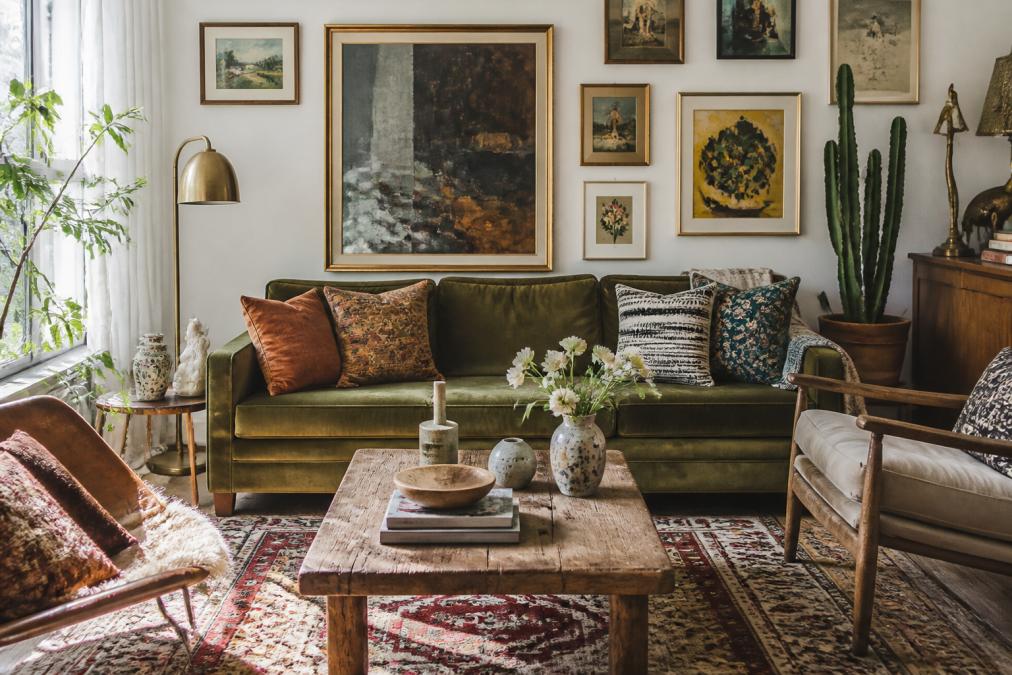
Eclectic home decor is a deliberate design approach that layers furniture, art, and objects from different periods, cultures, and styles into one room while keeping it visually unified. It is not a random collection of things you liked at different times.
The distinction matters. Many homeowners assume eclectic means “anything goes,” then end up with a room that feels chaotic rather than collected. Beautiful individual pieces sometimes never quite form a whole. The fix is almost always the same, and it starts before you buy a single item.
Eclectic vs. Maximalism: The Key Difference
Maximalism is about abundance. Eclectic design is about contrast held together by intent. A maximalist room fills every surface; an eclectic room can be relatively spare and still work, because the tension between a vintage piece and a contemporary one does the heavy lifting. If you’re drawn to Architectural Digest’s coverage of layered interiors, you’ll notice the best eclectic rooms share one trait: restraint in quantity, boldness in contrast.
Step 1: Find Your Throughline Before You Buy Anything
A throughline is the single element that repeats across a room and makes unrelated pieces feel related. It might be a color, a material, a finish, or a shape.
Without one, even expensive furniture reads as clutter. With one, a flea-market find sits comfortably beside a sculptural floor lamp. Common throughlines include a repeated metal finish, a narrow color palette, or a consistent wood tone.
Pick your throughline from something you already own and love. It’s far easier to build around an existing piece than to impose a concept on a room from scratch.
Step 2: How to Mix Furniture Styles Without the Clutter
To mix furniture styles well, anchor the room with one dominant style, then introduce contrasting pieces at a ratio of roughly two to one. Two traditional pieces to one modern accent keeps the room readable.
The most common mistake is splitting a room evenly between two styles. That produces visual stalemate. Let one style lead.
The 3-5-7 Rule for Spatial Arrangement
This simple framework keeps an eclectic room balanced:
- 3 materials in the room’s dominant pieces (for example, wood, metal, and glass)
- 5 textures across upholstery, rugs, and accessories
- 7 distinct objects of visual interest, no more, per sightline
Count from your main seating position. If you can see more than seven competing focal points, remove something.
Step 3: Building an Eclectic Interior Design Color Palette
An eclectic interior design color palette works best when it holds two or three core colors plus one accent. The core colors repeat across the room; the accent appears sparingly. Neutrals make the palette forgiving. A warm white wall lets a saturated accent chair or a patterned rug carry the room without fighting it.
What separates a palette that reads as collected from one that reads as random is the ratio. A reliable starting point is roughly 60 percent dominant neutral, 30 percent secondary color, and 10 percent accent. That 60/30/10 split gives the eye a clear hierarchy, so a saturated accent chair or a patterned rug can carry the room without overwhelming it. If you can’t tell which color is dominant from the doorway, the palette is split too evenly.
Pulling a Palette From a Piece You Already Own
The fastest way to build a palette that holds together is to extract it from one object you love, a rug, a painting, a ceramic vessel. Most practitioners find that a single patterned textile already contains three or four usable colors, which removes the guesswork of choosing from scratch. Photograph the piece, then sample its colors and assign each one a role: the most neutral becomes the wall and large upholstery, the mid-tone becomes secondary textiles, and the brightest becomes the accent.
Working With Global Influences and Design Eras
Mixing design eras and global influences is where eclectic rooms get their character. Pair a mid-century sideboard with a hand-thrown ceramic vessel, or set a traditional rug beneath a contemporary sculptural chair. The rule: each piece should have a clear reason for being there. A genuine collection of objects from your travels reads differently than a shelf of things bought to fill space. Curating a cohesive narrative requires a deliberate approach to mixing different aesthetic styles so that disparate elements feel like intentional parts of a singular, evolving home.
Era mixing follows a similar logic to color mixing. Let one era dominate the architecture and large furniture, then introduce a second era through lighting or seating and a third only through accessories. Three eras is usually the ceiling before a room starts to feel like a showroom rather than a home. When you mix global influences, tie them together with a shared color or material so the pieces read as a deliberate collection rather than a themed display.
Test a palette before you commit. Tape paint swatches to the wall and live with them for a few days, checking them in both morning and evening light. Colors shift dramatically between natural and artificial light, and a neutral that looks warm by day can read gray at night.
When to Break the Palette
A disciplined palette is a tool, not a rule. One deliberate outlier, a single unexpected color in a pillow, a piece of art, or a small accessory, adds the tension that makes eclectic rooms interesting. The key is that the outlier stays small and singular. Two or three outliers stop reading as intentional and start reading as noise.
Step 4: Balancing Textures in Interior Design for Visual Harmony
Balancing textures in interior design means pairing contrasting surfaces so the eye has something to rest on and something to explore. Smooth against rough. Shiny against matte.
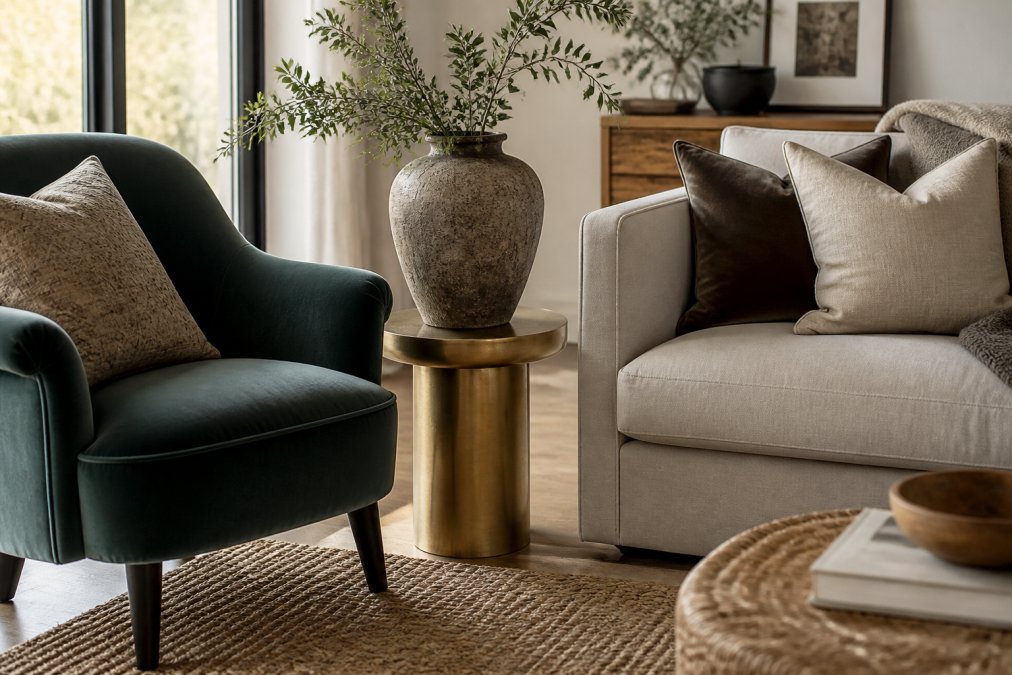
Start with the largest surfaces. A high-pile rug against a linen sofa against a stone coffee table gives you three textural registers before you add a single accessory. Sculptural lighting and layered decor then add the finishing contrast.
If a room feels flat, it’s usually a texture problem, not a color problem. Add one rough, matte, or handmade element before you change anything else.
Step 5: Sourcing Statement Pieces on a Budget
A statement piece doesn’t have to be expensive. It has to be distinctive. Estate sales, local makers, and vintage shops routinely turn up pieces with more character than anything mass-produced.
Budget-friendly sourcing works best when you buy slowly and buy for the throughline. One well-chosen vintage chair beats three generic ones, and it will hold its visual interest for years.
For pieces where durability genuinely matters, such as seating used daily or items in high-traffic rooms, it’s worth investing in craftsmanship. Verra Luxe Home offers a curated collection of premium decor, thoughtfully crafted for beauty and durability, ensuring pieces look considered and hold up to real life.
Step 6: Room-by-Room Application and Everyday Maintenance
Eclectic styling should be applied differently in each room, and it needs light ongoing maintenance to stay sharp. Most guides stop at the living room, but the rooms where eclectic style is hardest to pull off, and where it pays off most, are the kitchen and the bathroom.
| Room | Eclectic Approach | Maintenance Routine |
|---|---|---|
| Living room | One dominant style, two contrasting accents | Rotate accessories seasonally; dust sculptural pieces weekly |
| Bedroom | Calm throughline, one bold textile | Wash linens often; keep surfaces sparse |
| Dining room | Statement lighting, mixed seating | Clean wood and metal finishes monthly |
| Entryway | Layered rugs, one focal object | Shake rugs weekly; keep the focal point clear |
| Kitchen | Open shelving with mismatched ceramics, one vintage light fixture, a single patterned backsplash | Wipe shelves weekly; rotate displayed dishes so they don’t collect grease |
| Bathroom | One statement mirror, mixed metal hardware, a small collection of vessels for cotton and soaps | Squeegee glass daily; keep countertop objects to three or fewer |
Applying Eclectic Style in the Kitchen
The kitchen is where eclectic style most often fails, because function competes with display. The fix is to confine the eclecticism to a few deliberate zones: open shelving where mismatched ceramics can live, a single vintage or statement light fixture, and one patterned surface such as a backsplash or a runner. Keep the working triangle, sink, stove, refrigerator, visually quiet so the room still functions. A common pattern is to let the shelving carry the color and texture while the cabinetry stays neutral.
Applying Eclectic Style in the Bathroom
Bathrooms reward restraint. Because the room is small and the surfaces are hard, one strong statement, an antique mirror, a vintage rug, or a collection of apothecary bottles, is usually enough. Mix metals deliberately: a brass faucet against a matte black frame reads as intentional, while three unrelated finishes read as unfinished. Keep countertop objects to three or fewer so the room doesn’t tip into clutter.
Maintenance for a Collected Home
An eclectic home holds more objects than a minimalist one, which means more surfaces to dust and more materials to care for. A simple routine keeps it manageable:
- Dust weekly, deep-clean monthly. Feather dusters move dust around; a microfiber cloth or a vacuum with a brush attachment actually removes it (the EPA).
- Rotate, don’t accumulate. Store a portion of your accessories and swap them seasonally. Rotation keeps the room feeling fresh and reduces the number of objects collecting dust at any one time.
- Match the cleaner to the material. Wood wants a damp cloth and a mild soap; brass and copper tarnish and need a dedicated polish; ceramics and stone can chip or stain, so keep them out of direct sun and away from acidic cleaners.
- Protect textiles. Sun fades rugs, upholstery, and wall hangings (energy.gov). Rotate rugs periodically and use window treatments or UV film on the sunniest exposures.
The psychology here is straightforward: an eclectic home works when the eye can settle. Too many competing objects create low-grade visual stress. A clear focal point in every room gives the eye somewhere to land.
Don’t treat maintenance as an afterthought. Textiles fade, metal tarnishes, and ceramics chip. Rotating and cleaning pieces regularly is what keeps a curated room from drifting into a cluttered one.
Conclusion
The hardest part of eclectic styling isn’t finding beautiful pieces. It’s knowing which ones belong together, and that comes down to a throughline you can articulate. Verra Luxe Home offers a curated collection of premium decor, thoughtfully crafted for beauty and durability, so each piece earns its place in your space. If you want pieces that blend artistic elegance with everyday function, get started with Verra Luxe Home and build a room that feels unmistakably yours.
Frequently Asked Questions
What is the 3-5-7 rule in decorating?
The 3-5-7 rule is a styling guideline for arranging decorative objects in odd-numbered groups. You place three items in a small cluster, five in a medium arrangement, and seven in a larger display. Odd numbers create visual tension that feels more natural than symmetrical pairs. When you style eclectic home decor, this rule keeps collections from looking either sparse or crowded. Start with three objects of varying heights, then build outward as your shelf or surface allows.
What colors work best in an eclectic interior design color palette?
Eclectic rooms work best with a neutral base (warm white, greige, or soft taupe) plus two or three accent colors drawn from your existing art or textiles. Jewel tones like emerald, sapphire, and amber layer well against wood and brass. The key is repetition: pick your accents, then repeat each one at least three times across the room in different forms, such as a pillow, a vase, and a framed print. That repetition is what creates visual harmony instead of chaos.
How do you mix different furniture styles without it looking cluttered?
Anchor the room with one dominant style, then add contrasting pieces at a ratio of roughly 70 percent anchor to 30 percent contrast. Keep a consistent throughline, such as a shared wood tone, a repeated metal finish, or a unified color palette, so the juxtaposition reads as intentional. Limit yourself to two or three design eras per room. Give each statement piece breathing room with negative space, and avoid filling every surface. Clutter comes from too many competing focal points, not from mixing styles themselves.
How do I keep eclectic decor looking cohesive when I already own pieces I love?
Start by pulling everything you want to keep into one room and photographing it together. Look for repeated colors, materials, or shapes, and use those as your throughline. Remove anything that introduces a fourth or fifth competing color. Then fill gaps with pieces that echo what is already working rather than adding a new theme. A curated approach means editing as much as adding. If you are unsure whether a new piece fits, check it against your throughline before you buy.