Table of Contents
- Why Mixing Decor Styles Feels Hard (and Why It Shouldn’t)
- Start With the 70/30 Design Rule
- Pick a Primary Style, Then a Secondary One
- Use One Consistent Color Palette Across Styles
- How to Mix Patterns in Home Decor Without Chaos
- Balance Scale, Proportion, and Visual Weight
- Anchor the Room With Decor Accent Pillows and Textiles
- Common Mistakes to Avoid When Blending Styles
- Frequently Asked Questions
Last Updated: September 5, 2026
Mixing decor styles is the practice of blending two or more interior design aesthetics within a single space to create a personalized, collected look rather than a showroom-perfect one. Most homeowners abandon the idea because they fear visual chaos, but the tension between styles is exactly what gives a room character. At Verra Luxe Home, we curate premium pieces designed to bridge these gaps, and below we will show you exactly how to combine contrasting aesthetics without losing harmony. The secret is not in buying fewer statement items, but in applying structural rules that let disparate elements hold a conversation.
Why Mixing Decor Styles Feels Hard (and Why It Shouldn’t)
The difficulty stems from a misconception: that cohesion requires uniformity. In practice, rooms that feel flat are usually the result of playing it too safe with a single catalog look.
The real challenge is visual balance, which is achieved through deliberate contrast, not accidental accumulation. When you understand the mechanics of why certain pieces look good together, the guesswork disappears. This guide breaks mixing down into a repeatable process grounded in proportion, color, and repetition, so you can trust your instincts with a framework behind them.
Start With the 70/30 Design Rule
The most reliable safety net for mixing decor styles is the 70/30 design rule, where one dominant style claims roughly 70 percent of the visual real estate and a secondary style fills the remaining 30 percent. This ratio prevents the room from feeling like a design tug-of-war while still allowing meaningful contrast.
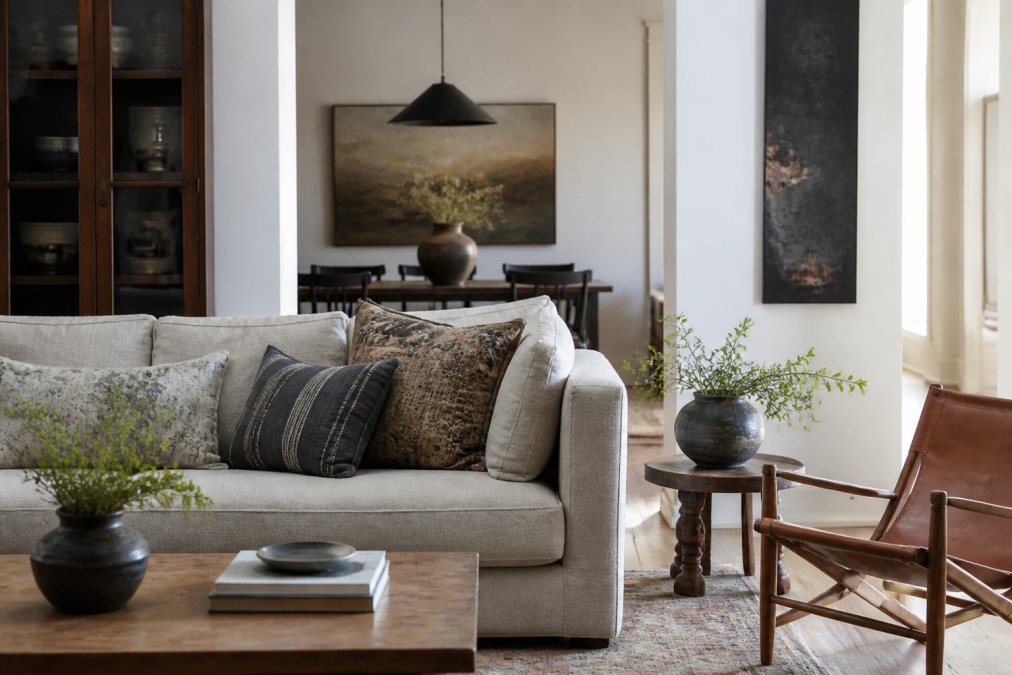
Apply the rule across furniture volume first, then layers. If your primary style is contemporary, that should dictate the sofa, the main rug, and the largest case goods. The secondary style, say vintage, appears in the accent chairs, the lighting, and the wall art. This split ensures the room reads as intentional rather than indecisive.
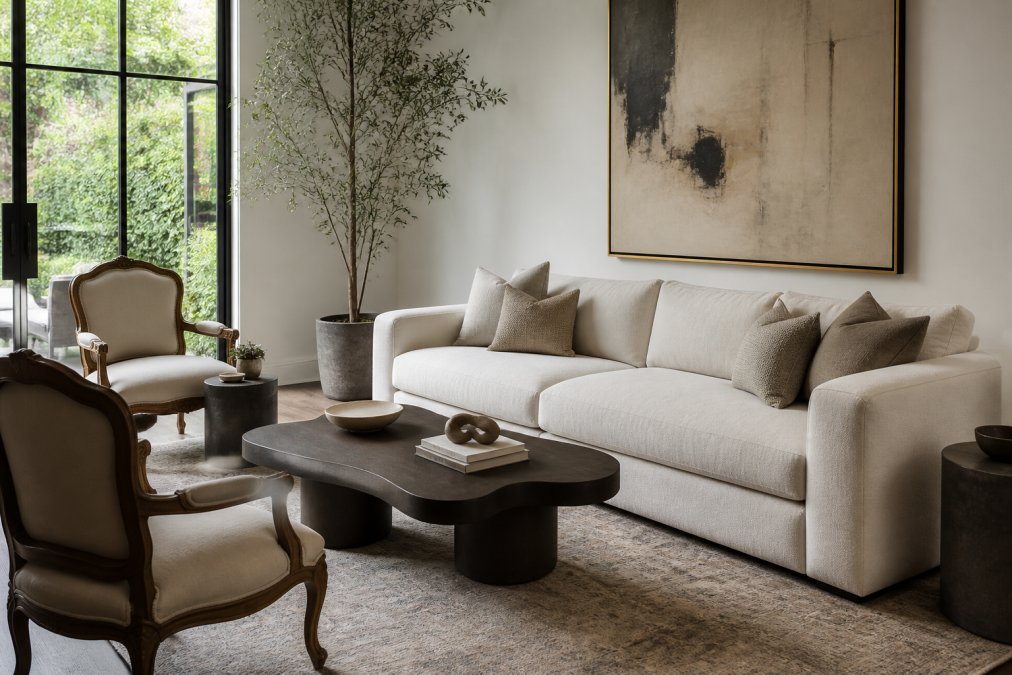
When assigning the 70 percent, choose the style that matches your architectural elements. If you have ornate crown molding, let traditional furniture lead, and use modern pieces as the 30 percent accent. This grounds the mix in the room’s fixed features.
Pick a Primary Style, Then a Secondary One
Before you buy a single piece, decide which two styles will share the space. A common mistake is pulling from three or four aesthetics, which dilutes the throughline and makes the room feel like a clearance aisle.
Strong pairings share at least one underlying value, such as a respect for craftsmanship or a preference for clean lines. This shared DNA is what makes the combination feel curated rather than chaotic. To make this concrete, here is a compatibility matrix of popular styles that are known to work well together, along with the specific design moves that make the pairing succeed.
| Style Pairing | Shared Value | Best Approach | What to Avoid |
|---|---|---|---|
| Mid-Century Modern + Industrial | Honest materials & exposed structure | Pair a walnut credenza with a black steel-framed bookcase. Use a leather sofa to bridge the two. | Avoid mixing too many wood tones; stick to one warm wood (walnut or teak) and let metal be the neutral. |
| Contemporary + Vintage | Appreciation for quality & craftsmanship | Let a vintage Persian rug or a mid-century armchair be the hero piece in a room of clean-lined contemporary furniture. | Avoid pairing delicate vintage pieces with oversized, bulky contemporary sofas that overwhelm them. |
| Scandinavian + Japandi | Simplicity, function & natural texture | Layer light woods (oak, ash) with linen upholstery and ceramic tableware. Use a low-profile platform bed as the anchor. | Avoid adding too many decorative objects; both styles rely on negative space to feel calm. |
| Farmhouse + Industrial | Utilitarian roots & rugged materials | Combine a reclaimed wood dining table with black metal chairs and exposed bulb pendants. | Avoid going overboard on rustic signs or overly polished factory pieces; the balance should feel lived-in, not themed. |
| Art Deco + Modern | Geometric forms & bold statements | Use a brass and glass coffee table or a velvet sofa in a jewel tone to inject glamour into a minimalist modern shell. | Avoid mixing too many metallic finishes; choose one dominant metal (brass or chrome) and use the other sparingly. |
| Bohemian + Modern | Comfort & personal expression | Anchor the room with a modern neutral sofa, then layer in global textiles, rattan pieces, and plants for a relaxed, collected feel. | Avoid letting the boho elements take over; keep the modern furniture as the structural base to prevent visual clutter. |
A common thread across all successful pairings is that the two styles must not compete for the same role. If both styles are heavily ornate, the room will feel busy. If both are starkly minimal, the mix will be invisible. The goal is to find a point of tension that feels intentional.
If you are unsure which styles to pair, start with your existing furniture. Identify the dominant style of your largest pieces, then choose a secondary style that contrasts in at least one dimension, era, material, or silhouette, but shares a common value like simplicity or craftsmanship. This approach grounds the decision in what you already own, making the mix feel personal rather than prescribed.
Use One Consistent Color Palette Across Styles
Color is the single most effective bridge between conflicting furniture silhouettes. When two styles share a cohesive color palette, the eye reads them as belonging together, even if their forms are entirely different.
Choose a dominant neutral for walls and large upholstery, then introduce accent colors that appear in both style camps. If your vintage chair is a burnt orange velvet, pull that exact tone into a contemporary throw pillow or a piece of wall art. This repetition of color creates a visual rhythm that unifies disparate forms.
A helpful approach is to limit the palette to three colors: one base, one secondary, and one accent. This constraint forces intentionality and prevents the rainbow effect that dilutes a mixed-style room.
How to Mix Patterns in Home Decor Without Chaos
Pattern mixing fails when every textile competes for attention at the same volume. The fix is to vary the scale of the prints so they layer rather than shout over each other.
Follow a simple hierarchy: one large-scale pattern, one medium-scale pattern, and one solid or subtle texture. A large floral on the drapes pairs well with a medium geometric on the accent pillows, anchored by a solid linen sofa. This structure creates depth without visual clutter.
Avoid placing two large-scale patterns directly next to each other, such as a bold floral rug under a heavily patterned sofa. The overlapping motifs create a strobe effect that makes the room feel restless and difficult to settle in.
Balance Scale, Proportion, and Visual Weight
Mixing decor styles is not just about color and pattern; it is about arranging objects so the room feels physically stable. A massive contemporary sectional next to delicate vintage side tables will feel top-heavy and disconnected.
The goal is to distribute visual weight evenly around the room. If one side holds a large, dark piece of furniture, balance it with a grouping of lighter objects on the opposite side, such as a tall plant, a floor lamp, or a cluster of framed art. This spatial planning prevents the eye from being dragged to one corner.
Anchor the Room With Decor Accent Pillows and Textiles
Textiles are the fastest, most affordable way to test a style mix before committing to large furniture purchases. Decor accent pillows act as the connective tissue between a modern sofa and a traditional rug, softening the transition between their forms.
Use pillows to introduce the secondary style’s color and texture in small doses. If your room is primarily contemporary with a global or boho secondary style, add pillows with handwoven textures, tassels, or ethnic motifs. This layering creates a curated, collected feel without overwhelming the space. Because pillows are easy to swap seasonally, they also let you evolve the mix over time as your taste refines.
Common Mistakes to Avoid When Blending Styles
The most frequent error is aiming for a perfect 50/50 split, which often results in a room that feels torn between two identities. The 70/30 rule exists to give one style the lead role.
Another pitfall is ignoring the psychological impact of the mix. A room that is all sharp angles and cold materials can feel unwelcoming, while a space with too many soft, rounded forms may feel unstructured. Consider how you want the room to feel, whether calm, energized, or creative, and let that guide which styles you pair. Research into environmental psychology and interior design suggests that our surroundings directly influence mood and stress levels. Similarly, the principles of the National Association of Home Builders design guidelines emphasize that proportion and scale are foundational to residential comfort. For those seeking a structured approach, the American Society of Interior Designers’ resources offer professional frameworks for achieving visual balance.
Finally, do not force a piece into a room just because you love it in isolation. If a vintage find clashes with your primary style, try moving it to another room or altering its context with new hardware or upholstery before giving up on it.
The Budget Trap: Mixing Styles Does Not Require a Full Redesign
A common misconception is that mixing styles requires buying all-new, high-end furniture. In practice, the most successful mixed-style rooms are built over time, layering new pieces with what you already own. The goal is to create contrast, not to replace everything.
Start by identifying the pieces you already have that you love. Those become the anchors. Then, instead of buying new furniture, look for small, high-impact additions that introduce the secondary style. A single vintage brass floor lamp can shift a modern room toward an eclectic feel. A set of industrial bar stools can pull a farmhouse kitchen into a more urban direction. These smaller pieces are easier to source secondhand and are less risky if the mix does not work.
If you are working with a tight budget, consider these practical moves:
- Paint is the cheapest bridge. A fresh coat of paint on an old dresser in a color pulled from your secondary style can make it feel like it belongs in a new context. For example, painting a traditional sideboard in a deep matte green can give it a modern, grounded feel that pairs well with contemporary art.
- Swap hardware for instant impact. Replacing the knobs and pulls on a dated piece of furniture with modern brass or black metal hardware is a low-cost way to shift its style identity. This works particularly well on dressers, cabinets, and desks.
- Use textiles to test a style before committing. Before buying a vintage sofa, try introducing the style through throw pillows, a rug, or curtains. If the look feels right after a few weeks, you can commit to larger pieces with confidence.
- Shop secondhand with a specific list. Instead of browsing aimlessly, write down the specific role a piece needs to fill (e.g., “a small wooden side table with a sculptural silhouette”). This prevents impulse buys that do not serve the mix.
- Repurpose what you have. A modern coffee table can be styled to feel more traditional by adding a brass tray and a ceramic vase. A traditional armchair can be reupholstered in a bold, contemporary fabric to bridge both worlds.
The most common budget mistake is buying a single “statement” piece that does not connect to anything else in the room. Instead, spend on small, repeatable elements, like lighting, textiles, and hardware, that can tie two styles together without requiring a full redesign.
By approaching the mix as an evolution rather than a one-time purchase, you avoid the financial and visual waste of a room that feels forced. The best mixed-style rooms look like they were collected over time, because they were.
Frequently Asked Questions
What is the 70/30 rule in decorating?
The 70/30 design rule is a ratio for visual balance. It means roughly 70 percent of a room should follow your dominant style, color palette, or furniture scale, while the remaining 30 percent introduces contrast: a secondary style, an accent texture, or a statement piece. This ratio helps the space feel intentional instead of split down the middle, which often reads as cluttered or indecisive.
How do you mix decor styles without making a room look messy?
Start with one visual anchor: a shared color palette, a consistent wood tone, or a single throughline like an era or a material. Apply the 70/30 design rule so one style clearly leads. Then edit hard. Remove anything that doesn’t serve the palette or the story. A curated look comes from what you leave out, not just what you add.
What are the rules for mixing patterns in home decor?
Keep three things in mind: scale, color, and repetition. Pair a large-scale pattern with a small-scale one, and keep a medium option between them. Repeat at least one color from each pattern elsewhere in the room, often through decor accent pillows or a throw. Limit yourself to three patterns per space, and let one pattern lead while the others support.
How can I blend modern and traditional decor styles?
Choose one as your dominant style, then let the other appear in 30 percent of the room. A traditional room gains energy from a modern sculptural coffee table or abstract art. A modern room warms up with a vintage rug or an antique sideboard. The trick is to bridge them with shared elements: similar wood tones, a neutral base, or matching metal finishes.
This article was written using GrandRanker