Table of Contents
- What Makes Durable Decor for Family Homes Actually Work
- Stain-Resistant Home Decor Materials Worth Investing In
- Family-Friendly Living Room Ideas That Don’t Look Compromised
- Safety Features and Child-Safe Design Without Sacrificing Style
- Pet-Specific Durability: Decor That Survives Dogs and Cats
- Longevity ROI: Why Durable Decor for Family Homes Costs Less Over Time
- Room-by-Room Durable Decor Checklist
- Conclusion
Last Updated: August 18, 2026
What Makes Durable Decor for Family Homes Actually Work
Durable decor for family homes starts with one principle: construction quality determines longevity, not surface appearance. A sofa that looks pristine in a showroom but uses a softwood frame and low-density foam will fail within two years of real family use. At Verra Luxe Home, we’ve built our entire curation philosophy around the idea that beautiful pieces must also survive the daily reality of children, pets, and high-traffic living.
Frame material, joinery method, foam density, and fabric weave all determine whether a piece holds up for a decade or falls apart in two years. Understanding these hidden factors is what separates a smart investment from an expensive mistake.
Hardwood Frames vs. Upholstered Furniture: Which Lasts Longer
Hardwood frames are the single most reliable indicator of furniture longevity. Kiln-dried hardwoods like oak, ash, and maple resist warping and cracking far better than engineered wood or softwood alternatives. Mortise-and-tenon or double-dowel construction outlasts stapled or glued joints by years.
The real question isn’t hardwood versus upholstered, most quality upholstered furniture uses hardwood frames underneath the fabric. It’s whether the frame inside your upholstered sofa is hardwood or particleboard. Press firmly on the seat edge and arm corners: a solid frame won’t flex. For family homes, furniture with exposed hardwood elements offers the best longevity ROI because the material is visible and verifiable before purchase.
High-Density Foam and Structural Integrity
High-density foam is the unsung hero of durable upholstery. Foam density is measured in pounds per cubic foot; seating foam below 1.8 lb/ft³ will compress and lose its shape within a year of regular use. Quality seating foam typically falls in the 2.0-2.5 lb/ft³ range for residential use. Some manufacturers add sinuous springs or eight-way hand-tied coil systems beneath the foam for additional structural support.
A common mistake is choosing cushion softness as a proxy for quality. Soft foam often has lower density and degrades faster. A firmer cushion with high-density foam will feel better and maintain its shape far longer.
Stain-Resistant Home Decor Materials Worth Investing In
Stain-resistant home decor materials span fabrics, hard surfaces, and coatings, each with different performance characteristics. According to The Carpet and Rug Institute’s fiber care guidance, the fiber type and weave structure of a textile are the primary determinants of stain resistance, not surface treatments alone. Many mass-market pieces rely on spray-on stain repellents that wear off within months of regular cleaning.
Performance Fabrics That Handle High-Traffic Areas
Performance fabrics are engineered textiles designed specifically for high-traffic areas. The most durable options for family living include solution-dyed acrylic, tightly woven polyester blends, and olefin. Thread count and weave tightness matter more than fiber type for everyday wear resistance. A tight plain weave in a synthetic blend will outlast a loosely woven linen in any high-traffic application.
For upholstery, look for fabrics rated above 15,000 double-rub cycles on the Wyzenbeek abrasion test, the practical floor for family use. Commercial-grade fabrics start at 30,000 double rubs and are worth the upgrade for sofas in active households. Natural fibers like wool and tightly woven cotton still have a place in durable decor for rugs and accent pieces in lower-traffic areas.
Washable Covers and Easy-Clean Textiles
Washable covers represent one of the most practical advances in family-friendly furniture design. Slipcover-style sofas and chairs with removable, machine-washable upholstery now feature tailored, fitted designs that look indistinguishable from fixed upholstery.
For hard surfaces, sealed natural stone, porcelain tile, and lacquered wood finishes are easy-clean choices. Unsealed porous surfaces, raw stone, unfinished wood, and unsealed grout are high-maintenance for family kitchens and bathrooms. A surface requiring quarterly sealing will almost certainly be neglected, leading to staining and deterioration.
For upholstered pieces you can’t remove and wash, look for fabrics treated with a durable water repellent finish applied at the fiber level during manufacturing. These hold up through multiple cleanings, unlike topical sprays.
Family-Friendly Living Room Ideas That Don’t Look Compromised
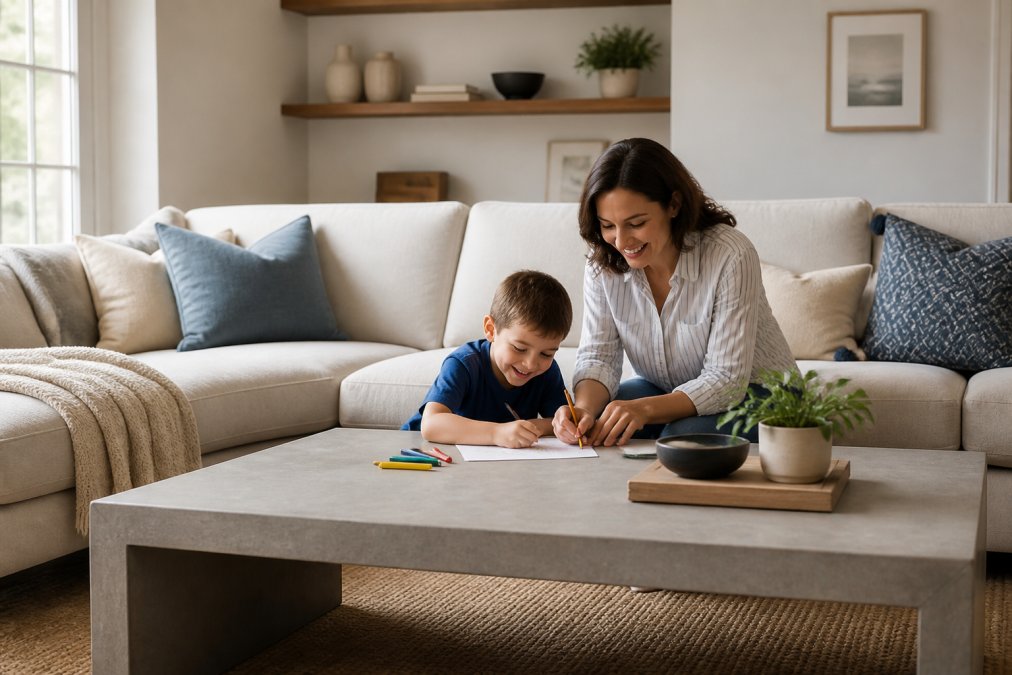
The biggest misconception about family-friendly living room ideas is that durability and style are in tension. They’re not. Design choices that produce resilient rooms, lower-profile furniture, rounded corners, neutral palettes, built-in storage, align with contemporary interior design aesthetics.
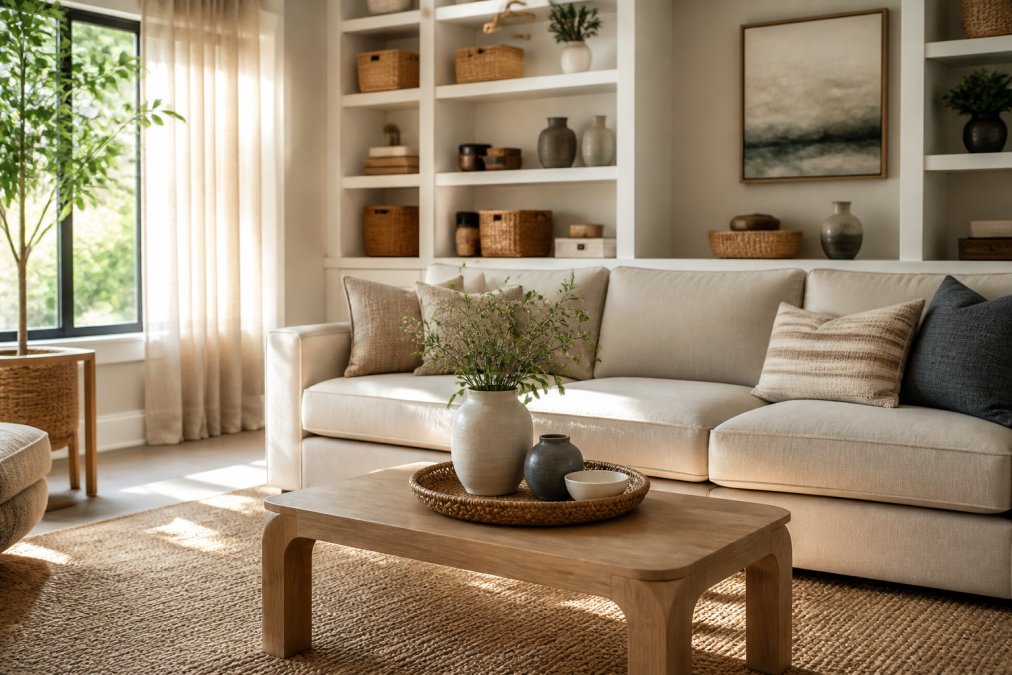
Treat durability as a design constraint that sharpens your choices. A living room built around functional design, clear sightlines, easy-access storage, and appropriately scaled furniture performs better visually and practically.
Color Palettes That Hide Wear and Tear
Mid-tone neutrals, warm taupes, greige, dusty sage, and soft terracotta hide wear and tear far better than very light or very dark colors. Pure white shows every mark; jet black shows every hair and dust particle. For high-traffic flooring, a rug with subtle pattern or texture variation conceals dirt and wear between cleanings far better than solid-color options. The same principle applies to upholstery: a fabric with slight texture or heathered weave looks presentable longer than smooth, solid-color equivalents.
Organic materials in their natural tones, linen, jute, rattan, have inherent color variation that makes them forgiving and align with modern decor aesthetics.
Storage Solutions That Manage Family Clutter
Clutter management is a structural problem, not a discipline problem. Homes that stay organized have storage built into the living room layout: ottomans with interior storage, built-in shelving, console tables with drawers, and attractive baskets. When storage is convenient and accessible, it gets used.
Every object that regularly appears in a room needs a dedicated home within that room. Children’s toys left on the floor become a safety hazard and accelerate wear on flooring and furniture. Attractive, durable baskets or a storage ottoman solve both the aesthetic and functional problem simultaneously.
Built-in and furniture-integrated storage reduces the surface area available for wear and tear, extending the life of your flooring and upholstery.
Safety Features and Child-Safe Design Without Sacrificing Style
Child-safe design is defined by rounded corners on hard furniture, stable bases that resist tipping, non-toxic finishes, and hardware that doesn’t present pinch or entrapment hazards. None of these features require aesthetic compromise.
The U.S. Consumer Product Safety Commission’s furniture tip-over guidelines identify freestanding furniture tip-overs as a significant home safety risk for children under six. Anchoring tall furniture to wall studs is the most effective mitigation. For flooring, area rugs should use non-slip rug pads, a home safety measure and rug preservation measure.
Water-based, low-VOC finishes on furniture and cabinetry reduce off-gassing in interior spaces. The EPA’s guidance on indoor air quality and VOC emissions notes that indoor VOC concentrations can be significantly higher than outdoor levels, particularly in newly furnished rooms. Rounded corners on coffee tables and side tables are the single most impactful safety upgrade in a family living room.
Pet-Specific Durability: Decor That Survives Dogs and Cats
Pet ownership changes the durability calculus significantly. Scratch-resistant surfaces, puncture-resistant upholstery, and materials that don’t trap pet hair are distinct requirements most design guides skip.
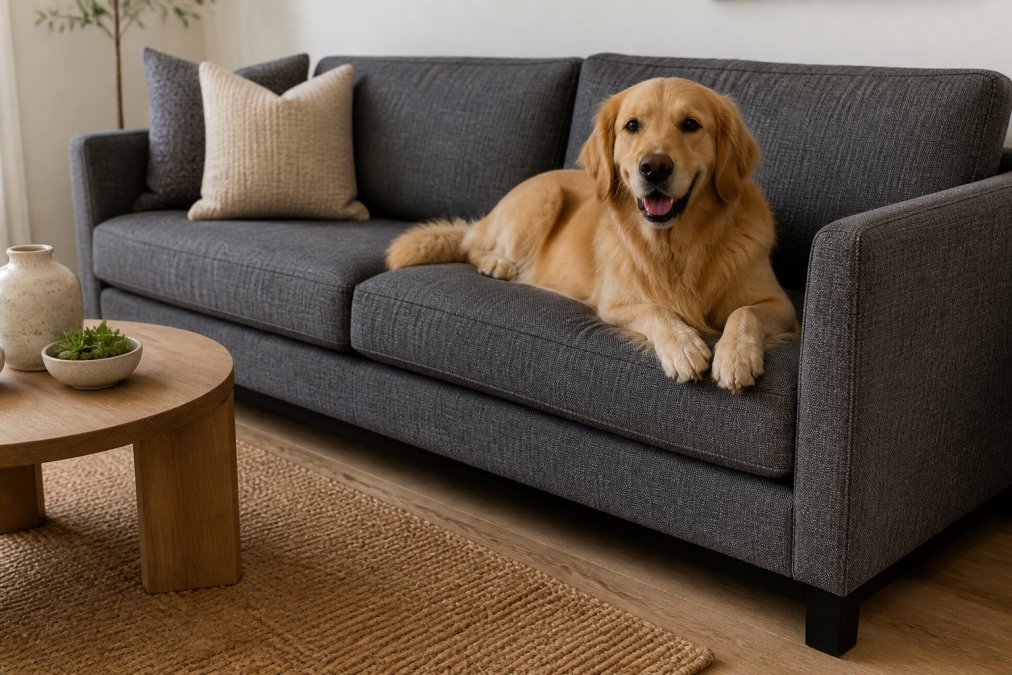
For upholstery, tightly woven fabrics with a flat weave are the most pet-resistant option. Loosely woven textiles, velvet, and bouclé catch claws and trap hair. Microfiber is one of the most practical choices for pet households: tightly woven, easy to wipe clean, and resistant to both claws and staining. The weave is too tight for claws to catch, and pet hair releases easily with a lint roller.
For flooring, hand-scraped or wire-brushed hardwood finishes disguise new scratches far better than smooth, high-gloss surfaces. Avoid sisal rugs in homes with cats, the coarse texture is irresistible for scratching. Flat-weave or tightly looped synthetic rugs are far more durable.
Sisal rugs in homes with cats are problematic. The coarse texture invites scratching, and natural fiber absorbs pet accidents deeply.
Longevity ROI: Why Durable Decor for Family Homes Costs Less Over Time
A piece that lasts 15 years at a higher initial cost almost always costs less per year than a cheaper piece replaced every three to five years. The calculation becomes clearer when you factor in the time and disruption cost of replacing furniture.
Many families find that investing in two or three anchor pieces of genuinely durable construction, a solid hardwood dining table, a performance-fabric sofa, a high-density foam sectional, and filling the room with more affordable accent pieces produces better long-term value than furnishing the entire room at a mid-market price point.
Durable decor with quality finishes requires less maintenance to stay presentable. A sealed hardwood table needs occasional oiling. A performance-fabric sofa needs a wipe-down. A cheaply constructed piece demands constant attention or replacement.
Room-by-Room Durable Decor Checklist
Use this checklist before purchasing any piece for a high-traffic family space.
| Room | Priority Material | Key Durability Feature | What to Avoid |
|---|---|---|---|
| Living Room | Performance fabric upholstery | 15,000+ double-rub rating | Loosely woven textiles, low-density foam |
| Dining Room | Kiln-dried hardwood table | Mortise-and-tenon joinery | Veneer over MDF, glass tops |
| Children’s Bedroom | Solid wood frames | Rounded corners, non-toxic finish | Particleboard, sharp hardware |
| Entryway | Porcelain tile or sealed stone | Scratch-resistant surface | Unsealed natural stone, light-colored grout |
| Kitchen | Quartz or sealed granite | Non-porous surface | Butcher block without regular oiling |
| Bedroom | High-density foam mattress base | Solid wood bed frame | Metal slat frames without center support |
Living Room checklist:
- Sofa frame is kiln-dried hardwood
- Upholstery fabric is rated for high-traffic use
- Coffee table has rounded corners
- Rug uses a non-slip pad underneath
- Tall furniture is anchored to the wall
Dining Room checklist:
- Table base uses hardwood or solid metal construction
- Chair joints are reinforced
- Table surface has a protective finish
- Upholstered dining chairs use performance fabric
- All furniture finishes are certified low-VOC
- No sharp hardware at child eye-level or below
- Freestanding furniture is anchored to wall studs
- Flooring includes a soft area rug with non-slip backing
Entryway checklist:
- Flooring is sealed and scratch-resistant
- Storage furniture is functional and accessible
- Any upholstered seating uses easy-clean, performance-grade textile
For sustainable material choices that support durability and indoor environmental quality, the Sustainable Furnishings Council’s material guidance offers practical reference for evaluating certifications and material standards.
Choosing durable decor for family homes is one of the highest-impact decisions during a renovation or refresh. The pieces you select today will either hold up gracefully through years of real family life or become a source of frustration and repeated expense. Verra Luxe Home’s curated collection brings together pieces that balance artistic elegance with genuine construction quality, hardwood frames, performance-grade textiles, and finishes built to last. Explore the collection and find investment pieces designed for how families actually live.
Frequently Asked Questions
What are the best stain-resistant fabrics for a family living room?
Tightly woven performance fabrics, including solution-dyed acrylic, microfiber, and olefin blends, resist stains best in family living rooms. These materials repel liquids before they absorb, and most can be spot-cleaned with mild soap and water. Look for upholstery labeled with a 'W' or 'WS' cleaning code. Slipcovers made from washable cotton-polyester blends are another practical option because you can machine-wash them when needed. Durable decor in high-traffic areas benefits most from fabrics with a double-rub count above 15,000.
How do you balance a minimalist aesthetic with a home that has young children?
Focus on furniture with clean lines and hidden storage rather than open shelving that collects clutter. Choose a restrained color palette in warm neutrals, these read as minimalist while masking everyday wear and tear far better than stark white. Rounded corners on coffee tables and consoles keep the look sleek while reducing injury risk. Investing in a few high-quality, durable decor pieces rather than many smaller accessories also keeps the space visually calm and easier to maintain with kids around.
How can I incorporate luxury decor into a home with young children without everything getting destroyed?
Prioritize investment pieces made from resilient materials: solid hardwood frames, scratch-resistant finishes, and performance upholstery. Reserve delicate or fragile accent pieces for rooms children don't use daily, such as a home office or primary bedroom. In shared spaces, choose organic materials like stone, sealed wood, and heavy-duty ceramics that age gracefully rather than showing damage. Washable area rugs and removable cushion covers let you maintain a refined look without treating every spill as a crisis.
Is durable home decor more expensive, and is it worth the higher price?
Durable decor typically costs more upfront than mass-produced alternatives, but the total cost over five to ten years is usually lower. A sofa with a hardwood frame and high-density foam holds its shape for years longer than a cheaper build, meaning fewer replacements. Stain-resistant and scratch-resistant finishes reduce repair and reupholstering costs. For current pricing on premium, long-lasting pieces, visit Verra Luxe Home's site directly, the right investment piece pays for itself by outlasting several budget replacements.
This article was written using GrandRanker

Leave a Reply