
Table of Contents
- Choosing the Right Lighting for Small Rooms: Start With a Plan
- How to Layer Lighting in a Room: Ambient, Task, and Accent
- Best Light Fixtures for Small Spaces: Space-Saving Options
- Lighting Placement for Small Rooms: Where Each Fixture Belongs
- Light Fixture Size Guide: Picking a Scale That Fits
- Bulbs, Color Temperature, and Controls That Make a Small Room Feel Bigger
- Rental-Friendly and No-Wiring Lighting Solutions
- Conclusion
- Frequently Asked Questions
Last Updated: October 9, 2026
Choosing the Right Lighting for Small Rooms: Start With a Plan
Choosing the right lighting for small rooms starts with a plan, not a shopping spree.
A small room is not a design problem. It is a design chance. Good lighting for small rooms can make 100 square feet feel like 150.
Below, we show you how to plan, layer, and place light so your room feels bigger, warmer, and more useful, plus the sizing and bulb details most guides skip.
Lighting for small rooms is not about one bright fixture. It is about three layers of light working together: ambient, task, and accent.
Measure First: Room Dimensions and Ceiling Height
Measure before you buy anything. Write down room length, room width, and ceiling height.
These numbers decide what fits. A low ceiling rules out long pendants. A narrow room needs lights that do not eat floor space.
Here is what to check:
- Room length and width in feet
- Ceiling height, floor to ceiling
- Window placement and how much daylight enters
Ceiling height changes everything. Standard ceilings sit around 8 to 9 feet; higher ceilings handle long pendants and chandeliers, while low ceilings do better with flush mounts and wall sconces.
Match the Lighting to How the Room Is Used
A bedroom needs soft, dimmable light. A workspace needs bright, focused light. The same small room can do both if you plan for it.
Ask one question first: what happens in this room most?
- Small bedrooms: soft ambient light plus a focused reading light
- Home offices: bright task light on the desk, softer light elsewhere
- Guest rooms: flexible, dimmable light that suits any visitor
Get this wrong and no fixture will fix it. A single overhead light in a room used for reading and relaxing will always feel harsh.
How to Layer Lighting in a Room: Ambient, Task, and Accent
How to layer lighting in a room comes down to three jobs: ambient light fills the space, task light helps you see, and accent light adds depth.
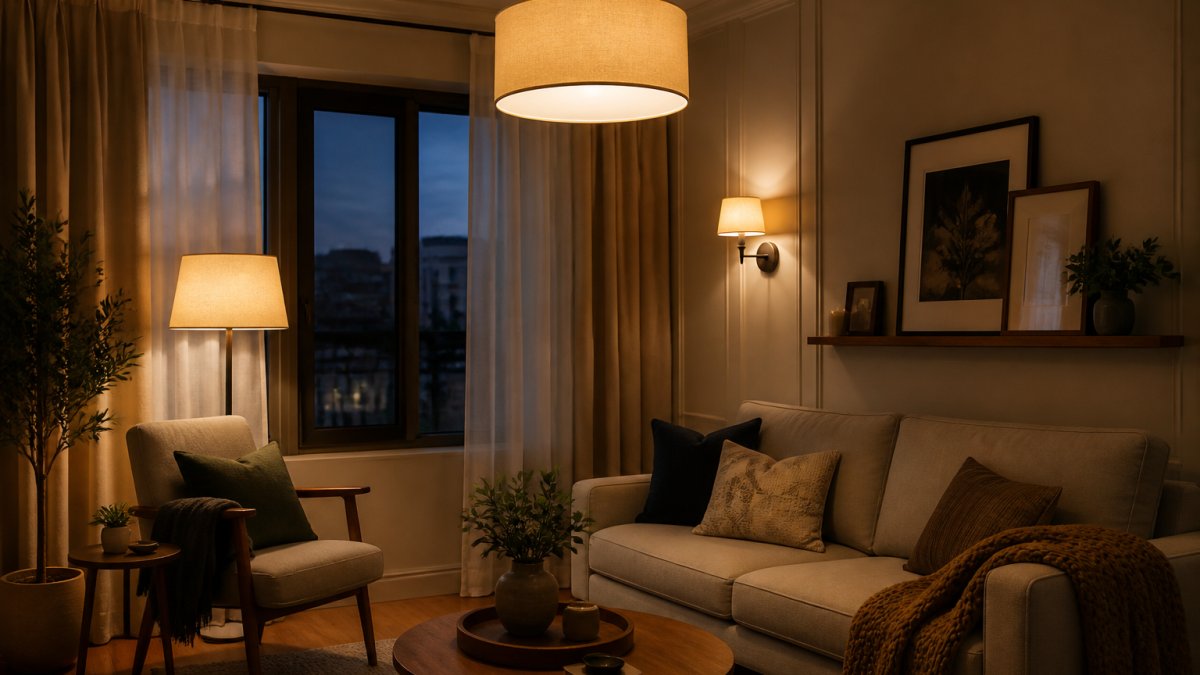
Ambient lighting is your base layer, replacing daylight after dark. Ceiling lights and larger floor lamps usually do this job.
Task lighting is focused light for a specific activity: reading lights, desk lamps, and under-cabinet lights.
Accent lighting adds drama and draws the eye. Wall sconces and small uplights are common choices.
Here is a practical rule:
- Start with ambient light that covers the whole room
- Add task light where you read, work, or cook
- Finish with accent light to soften corners and add warmth
Put each layer on its own switch or dimmer. This lets you change the mood in seconds without touching a single bulb.
Best Light Fixtures for Small Spaces: Space-Saving Options
The best light fixtures for small spaces pull double duty. They light the room and free up floor and surface space.
Here are the options that work hardest in tight rooms:
- Flush-mount ceiling lights: sit close to the ceiling, great for low rooms
- Semi-flush mounts: add a little drop without crowding
- Wall sconces: light without using floor space
| Fixture | Space Saved | Best For |
|---|---|---|
| Flush-mount ceiling light | High | Low ceilings, general light |
| Wall sconce | High | Bedside, hallway, sofa wall |
| Plug-in sconce | High | Rentals, no wiring |
| Slim floor lamp | Medium | Reading corners |
| Small table lamp | Medium | Bedside, desk |
Wall Sconces and Plug-In Sconces That Free Up Floor Space
Wall sconces are the quiet heroes of small rooms. They mount on the wall, so they take up zero floor space. That matters in a narrow room where every inch counts.
Plug-in sconces go one step further: no wiring at all. Plug them into a standard outlet and hang them where you want.
Use sconces for:
- Bedside reading without a nightstand
- Lighting above a sofa or bench
- Brightening a dark hallway
Mount sconces too high and they stop working as reading lights. Keep the bottom of the shade near eye level when you sit.
Lighting Placement for Small Rooms: Where Each Fixture Belongs
Lighting placement for small rooms follows a few simple rules. Get the height and spacing right and the room feels balanced. Get them wrong and you get glare, shadows, and dark corners, the three problems that make a small room feel smaller than it is.
Placement Heights and Spacing
- Ceiling lights: center of the room, or centered over the main seating area
- Pendant lights: about 30 to 36 inches above a table or counter
- Wall sconces: around 60 to 66 inches from the floor for general light
Fixing Glare
Glare happens when a bright source sits in your line of sight or reflects off a shiny surface. In a small room, glare is worse because you are closer to every light.
Common causes and fixes:
- Bare bulb at eye level: add a shade, a diffuser, or a lower-wattage bulb
- Shiny countertops or screens reflecting a ceiling light: move the light off-axis, or add a shade that directs light down instead of out
- A lamp with no shade on a desk: switch to a shaded task lamp and aim the light at the work surface, not your eyes
Fixing Shadows
Shadows form when a light sits behind you or too far to one side. The fix is almost always to move the light in front of the task or add a second source.
- Reading in bed: a single bedside lamp throws a shadow across the page. Add a second light, or use a sconce mounted slightly forward of your shoulder
- Working at a desk: a lamp behind your hand casts a shadow over your work. Place the lamp to the side opposite your writing hand, and slightly forward
- Cooking at a counter: overhead light alone leaves your body shadowing the cutting board. Add under-cabinet task light
Fixing Dark Corners
Small rooms collect dark corners because light from a central fixture falls off before it reaches the walls. Add a low-level source in the corner itself.
- Place a slim floor lamp in the corner and angle it toward the ceiling
- Add a small uplight behind a plant or chair to wash the wall
- Use a plug-in sconce on the darkest wall
Placement Mistakes to Avoid
- Putting the only light behind where you sit
- Hanging pendants too high, so they light the ceiling instead of the table
- Mounting sconces too high to work as reading lights
A single bright ceiling light in a small room almost always creates glare at the source and shadows everywhere else. Add at least one task light and one accent light before you decide the room is “too dark.”
Angle floor lamps toward the ceiling. Bouncing light upward makes the room feel taller and softer, and it eliminates the harsh pool of light a downward-facing lamp creates.
Light Fixture Size Guide: Picking a Scale That Fits
A light fixture size guide saves you from the most common small-room mistake: buying a fixture that is too big or too small. Scale makes a room feel intentional, get it wrong and even a beautiful fixture looks like a mistake. Proper proportions serve as the foundation for avoiding a cluttered look, ensuring that every element in the space contributes to a sense of balance rather than competing for visual dominance.
Sizing a Ceiling Fixture
Start with the room’s footprint. Add the length and width in feet, then convert that total to inches. That number is a good target diameter for a round ceiling fixture.
- A 10 by 12 foot room: 10 + 12 = 22, so aim for a fixture about 22 inches wide
- An 8 by 10 foot room: 8 + 10 = 18, so aim for a fixture about 18 inches wide
- A 12 by 14 foot room: 12 + 14 = 26, so aim for a fixture about 26 inches wide
For a rectangular room, keep the fixture’s width at roughly one-third to one-half the width of the shorter wall. A fixture spanning more than half the short wall will crowd the ceiling and make the room feel smaller, not larger.
Hanging Heights That Actually Work
Diameter is only half the equation. Height matters just as much, especially in low-ceiling rooms.
- Flush mounts: hug the ceiling, ideal for ceilings under 8 feet
- Semi-flush mounts: drop 4 to 8 inches, fine for 8 to 9 foot ceilings
- Pendants over a table: hang the bottom of the shade 30 to 36 inches above the tabletop
A quick rule for low ceilings: the lower the ceiling, the closer the fixture should sit to it. In an 8 foot room, a flush mount or slim semi-flush is almost always the right call.
Spacing Multiple Fixtures
If you use more than one fixture, pendants over an island, sconces along a wall, or recessed lights across a ceiling, spacing decides whether the room feels even or spotty.
- Pendants over an island: space them 24 to 30 inches apart, and keep them at least 6 inches in from each end of the island
- Recessed lights: space them roughly half the ceiling height apart. In an 8 foot room, that is about 4 feet between lights
- Wall sconces: space them 4 to 6 feet apart along a hallway, or one on each side of a bed or mirror
Matching Fixture Width to Furniture
A fixture should relate to what sits under it. For a dining table, keep the fixture narrower than the table with at least 6 inches of table edge on each side. For a sofa, a fixture or pair of sconces should span roughly two-thirds of the sofa’s width. For a bed, a pair of bedside sconces should sit about 24 to 30 inches above the mattress and roughly shoulder-width apart when you are sitting up.
Scale Tips for Narrow and Low Rooms
- Choose slim profiles over wide drum shades in narrow rooms
- Use vertical shapes, tall sconces, narrow pendants, to draw the eye up
- In low rooms, favor flush mounts, recessed lights, and wall sconces over anything that hangs
Before you buy, cut a paper template to the fixture’s listed diameter and tape it to the ceiling. A 22 inch circle looks very different on a ceiling than it does on a product page.
Bulbs, Color Temperature, and Controls That Make a Small Room Feel Bigger
Bulb choice changes how big a room feels. Color temperature, measured in kelvin (K), sets the mood.
- Warm white (2700K to 3000K): cozy, best for bedrooms and living areas
- Bright white (3500K to 4100K): crisp, good for kitchens and offices
- Daylight (5000K and up): cool and bright, best used in small doses
For most small rooms, warm white is the safe pick. It flatters skin tones and wood finishes.
Then add controls. Dimmable lighting lets you drop the brightness at night.
For energy use, look for LED bulbs. They run cool and use far less power than older bulbs.
Warm white light plus a dimmer makes a small room feel bigger and calmer. Cool white light at full power does the opposite.
Rental-Friendly and No-Wiring Lighting Solutions
Renters face one big limit: no new wiring. The good news is you can light a small room well without touching a single wire.
Rental-friendly options include:
- Plug-in wall sconces with a cord cover
- Floor lamps that plug into any outlet
- Battery-powered puck lights for closets and shelves
These options also suit anyone avoiding an electrician, they install in minutes and move with you when you go.
Conclusion
Small rooms ask more of your lighting than big ones do, that is the challenge, and the fun part. Measure the room, layer the light, and pick fixtures that save space instead of eating it.
Our curated collection of premium decor blends artistic elegance with practical function. Every piece is chosen to help you turn a tight room into a sanctuary of style, crafted for beauty and built to last so your space feels considered, not crowded.
Shop Now and light your small room with confidence.
Frequently Asked Questions
What type of lighting is best for a small room?
Layered lighting works best. Combine ambient light from a ceiling fixture or pendant for general brightness, task lighting such as a table lamp or floor lamp for reading and work, and accent lighting like a wall sconce or small uplight to add depth. A single overhead fixture flattens a small room and casts harsh shadows, while three or four lower-output sources at different heights make the space feel intentional and larger. Dimmable fixtures give you the most control across daytime and evening use.
What size light fixture should I choose for a small room?
For a ceiling fixture, add the room’s length and width in feet, then treat that number in inches as the maximum fixture diameter. A 10 by 12 foot room supports a fixture up to about 22 inches wide. For a pendant over a table or island, keep the shade between 12 and 18 inches wide and leave at least 30 to 36 inches of clearance between the shade bottom and the surface below. Scale matters more than style here, since an oversized shade overwhelms a compact room.
How can I add lighting to a small room without taking up floor space?
Wall sconces and plug-in sconces are the most effective options because they mount at eye level and leave the floor and surface areas clear. Swing-arm sconces work well beside a bed or reading chair, and plug-in versions need no wiring, so they suit rentals. Slim ceiling pendants and flush-mount fixtures also free up floor space compared with floor lamps. If you do use a floor lamp, choose a narrow base and place it in a corner where it reads as part of the architecture rather than clutter.
Where should you place lights in a small room?
Place ambient light at the center of the ceiling, task light near the surface it serves, and accent light on the walls opposite the main seating. In a narrow room, put a sconce or uplight on the long wall to draw the eye upward and make the ceiling feel higher. Avoid placing a lamp directly in front of a mirror or glossy surface, which doubles the glare. Keep at least one light source behind the seating position so faces are lit from the front, not silhouetted.